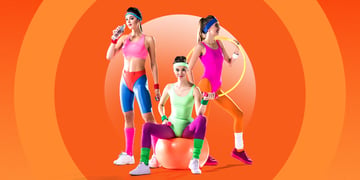
Bright-colored leotards, tight shorts, and blasting pop hits–yes, Jazzercise is back and is now finding its place among Gen Z. Here's everything you need to know before trying this fitness routine.
Jazzercise is a dance-based workout that combines cardio with strength training and includes elements of pilates, hip-hop, yoga, and kickboxing.
The fitness routine was founded by dancer Judi Sheppard Missett in 1969 and quickly rose to popularity as a fun and effective workout. It also broke societal barriers by encouraging women to engage in rigorous exercise, which was then deemed 'unladylike.'
Today, Jazzercise classes take place in 16 countries globally, and are being discovered by Gen Z, according to media reports. So what are its benefits and risks, and can Jazzercise alone replace other fitness routines?
-
Jazzercise is a dance-based workout that combines cardio with strength training.
-
Jazzercise workouts may feel more like a party than exercise, providing mental health benefits like improved mood and stress reduction.
-
The physical health benefits of Jazzercise include increased endurance and stamina. It can also help maintain muscle mass and bone density.
-
Those who want to achieve maximum health benefits may choose to pair Jazzercise workouts with dedicated strength training and mobility-focused workouts like yoga and pilates.
The benefits of Jazzercise
Jazzercise is a great cardio workout that can help increase endurance and stamina while burning calories and supporting heart health, Denise Chakoian, a Rhode Island certified fitness trainer, tells WellnessPulse.
Because the classes often involve the use of light weights or resistance bands, people have the opportunity to do strength training, which is important for maintaining muscle mass and bone density in the body.
While denser bones benefit people of all ages, they are especially important for women undergoing menopause, as dropping estrogen levels accelerate bone density loss.
There aren't studies examining the benefits of Jazzercise specifically, but dancing has been shown to positively affect mental and physical health. For example, engaging in dance exercise programs was associated with improved muscle strength, balance, and flexibility in older adults.
Dancing may also improve cognitive function in both healthy adults and those with mild cognitive impairment.
Dance exercises like Zumba have been linked with lower blood pressure and triglyceride levels. In people who are overweight and have obesity, dancing may help lose weight and improve body composition, especially among those under the age of 45.
Individuals over 40 who participate in dancing may be at a 46% lower risk of death from cardiovascular disease, according to a 2016 study.
But Jazzercise's benefits go far beyond physical health improvement. Chakoian says the high-energy music and choreography make people feel like they are at a party with their friends instead of exercising in a class.
The social interaction and mental stimulation experienced while exercising in a group to music can also improve mood and reduce stress. This mental health benefit can be just as valuable as the physical benefits of exercise. It is an inclusive activity that can be enjoyed by people of all ages and fitness levels, with modifications usually provided by the instructor for higher and lower intensity moves.
Denise Chakoian
The risks of Jazzercise
Chakoian says the risks of Jazzercise are similar to those of other high-intensity, choreographed fitness programs. Repetitive dance steps and jumping can strain knees, ankles, and hips, especially in people with joint problems or limited mobility.
Moreover, people without good body awareness who skip proper warm-up and cool-down may risk muscle strain or overuse injuries.
"The choreography can also feel overwhelming for beginners, and if form is lost in trying to keep up, it increases the chance of injury," she says.
Is Jazzercise enough to stay healthy?
Adults are recommended to engage in at least 150 to 300 minutes of moderate-intensity physical activity a week, or 75 to 150 minutes of vigorous physical activity, according to the Physical Activity Guidelines for Americans.
Chakoian says Jazzercise workouts can help people meet the basic recommended guidelines for physical activity, especially if they are consistent with attending classes a few times a week.
"Jazzercise offers cardio conditioning, calorie burning, and some light strength training. This can make for a great base for overall health, but it doesn't always provide all parts of a balanced fitness program," she says.
Those who want to build or maintain more muscle mass, bone density, or overall strength may want to add in some dedicated resistance training with heavier weights.
Flexibility and mobility can also be overlooked, so pairing Jazzercise with yoga, Pilates, or focused stretching sessions can help balance the body and prevent injury, Chakoian says.
For someone who enjoys Jazzercise and wants it to be their main workout, the best approach is to keep it as the core cardio piece and combine it with strength and mobility training two to three times a week for a complete, long-term program.
Denise Chakoian
The takeaway
Jazzercise is a great cardio and strength training workout. While several classes a week may be enough to meet the recommended minimum physical activity levels, those who want to achieve maximum benefits may want to pair Jazzercise with dedicated resistance training and yoga or pilates.
6 resources
- Office of the Assistant Secretary for Health. Physical Activity Guidelines for Americans.
- Annals of Geriatric Medicine and Research. A meta-analysis of the effects of dance programs on physical performance: Appropriate health promotion for healthy older adults.
- Aging Clinical and Experimental Research. Effects of dance intervention on global cognition, executive function and memory of older adults: a meta-analysis and systematic review.
- The Journal of Sports Medicine and Physical Fitness. Benefits of Zumba Fitness® among sedentary adults with components of the metabolic syndrome: a pilot study.
- PLOS One. Is dancing an effective intervention for fat loss? A systematic review and meta-analysis of dance interventions on body composition.
- American Journal of Preventive Medicine. Dancing participation and cardiovascular disease mortality.





Your email will not be published. All fields are required.