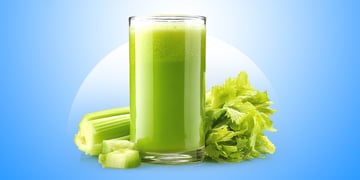
In 2019, interest in celery juice surged. Celebrities like Gwyneth Paltrow and Miranda Kerr shared that they start their day with a glass of it. This was not a typical celebrity trend, since they weren’t the ones who started it.
They were inspired by self-proclaimed ‘doctor’ Anthony William, who convinced them that celery juice offers many health benefits. The trend quickly spread through the wellness world and has not faded.
Even now, wellness influencers on TikTok and Instagram promote this green juice as a cure-all for health problems. That is why we decided to revisit this topic and finally settle the ‘is celery juice a superfood’ discussion.
-
Celery juice drinkers claim that it helps with weight loss, fatigue, acne, diabetes, cancer, bloating, and other health problems. Healthcare specialists have debunked these claims because it lacks scientific evidence.
-
Celery juice drinkers recommend drinking 16 oz every day. This is roughly 20% of the recommended daily intake of salt.
-
For people on warfarin (blood thinners), daily consumption of celery juice can alter blood clotting.
-
While celery juice shouldn’t replace water, incorporating celery juice can be a tasty, hydrating addition to your daily fluid intake.
Extreme health claims
If you start researching whether you should drink celery juice, you might get lost in the information bubble.
Williams, who started this movement, claims that drinking celery juice on an empty stomach in the morning is a miracle potion. According to him, what health problems can it solve? The list is long, so we decided to narrow it:
- Balances blood sugar and blood pressure
- Helps with weight loss
- Helps with fatigue, brain fog, acne, eczema, ADHD, diabetes, autoimmune disorder, Lyme disease, psoriasis, and more
- Flushes toxins from the liver and brain
- Relieves bloating, acid reflux, and digestive problems
- Fights cancer
Does science back it up?
It is already known that the liver and other organs are responsible for removing toxins from the body. There is no research proving that celery juice does a better job than your body itself.
“The hype comes in with the exaggeration that celery juice has extraordinary benefits: detoxifying the liver, reversing chronic disease, destroying pathogens,” says Nutritional Consultant Barbara Smith, “That's just hype with no basis in fact whatsoever.”
She adds that celery contains the antioxidants apigenin and luteolin, both with known anti-inflammatory activity. This is often used in the celery juice movement as the main reason to consume it. It is believed that those antioxidants fight cancer.
However, research on this topic uses isolated apigenin and luteolin rather than the foods that contain them. For example, a 2025 comprehensive review examined anticancer effects and toxicity of these compounds in animal studies. Researchers acknowledged that they have shown anticancer effects, but noted that neither luteolin nor apigenin has been validated in clinical trials.
The other statement is that a cup of celery juice will solve digestion problems. Medical Doctor Alexander Acosta actually debunks this claim, saying it has a laxative effect at best by leaving mannitol behind.
“Mannitol is a sugar alcohol that draws water into the intestinal lumen,” he further explains, adding that in people with sensitive digestive systems, that effect causes bloating and loose stools rather than the smooth digestion advertised.
Smith adds that if you're trying to help your digestive health, you're much better off eating the celery than drinking the juice. “Juicing celery gets rid of all the fiber that actually feeds the good bacteria in the digestive system,” she sums up.
Does it treat psoriasis?
Kim Kardashian was one of the early enthusiasts of the celery juice movement because of the promise that it would help with psoriasis. It is an autoimmune condition that causes skin cell turnover, leading to itching and scaly patches.
Celery contains psoralen, a natural plant compound that becomes biologically active when exposed to ultraviolet A (UVA) light. In medicine, it is used in a treatment called PUVA (psoralen + UVA) therapy for psoriasis.
After psoralen is taken orally or applied to the skin, it is activated by controlled exposure to UVA light. As a result, it binds to DNA in skin cells and slows their rapid growth, which is a key problem in psoriasis. At the same time, it reduces inflammation. This combined effect helps decrease scaling, redness, and thickness of the skin.
Celery juice drinkers decided to use this treatment as an explanation for why drinking it is also effective. However, the National Psoriasis Foundation warns that this claim is incorrect. Simply consuming large amounts of celery is not a proven cure for psoriasis, and excessive sun exposure can be dangerous. People who consume it daily and are exposed to high ultraviolet light may be at higher risk of developing a skin photosensitivity reaction.
Nutritional profile of celery juice
If you saw the movement, you definitely noticed that people are advised to drink 16 oz (475 ml) of celery juice daily. We decided to compare the drink's nutritional profile with the amount of celery needed to make it. Follow the table below for this information.
| 16 oz of celery juice | 9–12 stalks of celery (26 oz or 737 g) |
| 71 kcal | 111 kcal |
| 5.8 g of carbohydrates | 9.1 g of carbohydrates |
| 457.8 mg of sodium | 714.9 mg of sodium |
| 7.6 g of fiber | 11.8 g of fiber |
| Potassium: 48% of the DV | Potassium: 75% of the DV |
| Vitamin K: 152% of the DV | Vitamin K: 237% of the DV |
| Vitamin B: 42% of the DV | Vitamin B: 66% of the DV |
Smith points out that the reason people might prefer taking celery juice is because it is more convenient. “It is better for you to take the whole celery or blend it,” she concludes. Pharmacist and Director at Herba Health, Jane Moon, agrees and explains that one medium stalk of celery has the same nutrient density as eight ounces of juice.
“Whole cellulose fiber is good for the gut, BN, and for stabilizing blood sugar and increasing satiety, which juice does not do,” she further explains.
High in sodium
According to the Dietary Guidelines for Americans (DGA), adults and children over 14 should limit sodium intake to less than 2,300 mg per day. If you look at the table above, 16 oz of celery juice is roughly 20% of the recommended daily intake of salt. “That is a concern for people with high blood pressure,” warns Moon.
Even so, William convinced people that it is actually good for their health. He uses the non-existent term ‘cluster salts.’ If you search for it, you will find that it is apparently a subgroup of sodium compounds found in celery with potential health benefits.
Acosta denies these claims, saying there has not been a single peer-reviewed study that has identified the cluster salts, which supposedly restore stomach acid and repair the gut lining. “That term doesn't appear in any biochemistry or gastroenterology literature I've read or reviewed,” he concludes.
Does celery juice have actual benefits?
There are many claims about the potential health benefits. Yes, it contains anti-inflammatory compounds, as mentioned before.
One study in mice fed a high-fat diet found that fermented celery juice reduced body weight and improved blood glucose levels. This shows that fermentation enhances the drink’s biological activity and potential metabolic benefits. However, this study was done on animals and cannot be directly applied to humans without further clinical studies.
Even if high-sodium intake from celery juice negatively affects people with high blood pressure, people who promote celery juice say it lowers blood pressure and cite research to support this. At first, these claims might sound legit until you look deeper.
For example, a 2025 systematic review analyzed 10 studies involving 511 participants to evaluate celery’s effects on blood pressure, blood sugar, and blood lipids. They concluded that celery may lower blood pressure, and the effect on blood sugar was unclear, as studies yielded mixed results.
However, there is a catch. Many of the measurable benefits came from standardized celery seed extracts, not from whole celery or juice. This is likely because seeds contain higher levels of active compounds. Also, higher doses (above 1,000 mg per day) were generally more effective.
The biggest celery juice benefit is probably hydration. “Celery juice is about 95% water,” says Acosta. While it shouldn’t replace water, incorporating celery juice can be a tasty, hydrating addition to your daily fluid intake.
It also provides small but useful amounts of potassium and vitamin K. Potassium helps regulate fluid balance, while vitamin K supports blood clotting. Though celery is not high in either nutrient compared to some other foods, regular consumption can still contribute to overall intake as part of a balanced diet.
However, high vitamin K doses might not be great for everyone. Acosta warns that for patients on warfarin (blood thinners), daily consumption of celery juice can cause shifts in international normalized ratio readings. It measures how quickly blood clots. For people who are on blood thinners, it might raise the risk of bleeding. “In ways that destabilize carefully managed dosing”, says Acosta, noticing that the patients never link their new habit in the morning to the problem.
Bottom line
In all of this discussion about celery juice, the most important thing is that a balanced diet is key to a healthy lifestyle. Juices can’t replace that.
If you feel that a cup of squeezed celery in the morning helps you wake up and start the day with energy, there is nothing wrong with that. However, this should not be driven by false facts online.
Before believing them, do some research on the topic and see what actual studies and healthcare specialists say. If you still have questions or are not sure how celery juice will affect your health or interact with your medication, talk with your healthcare provider.
10 resources
- Frontiers in Nutrition. Effects of celery (Apium graveolens) on blood pressure, glycemic and lipid profile in adults: a systematic review and meta-analysis of randomized controlled trials.
- Journal of Environmental Science and Health. Potential anticancer effects and toxicity of flavones luteolin and apigenin in vivo.
- Food & Function. Beneficial impacts of fermented celery (Apium graveolens L.) juice on obesity prevention and gut microbiota modulation in high-fat diet fed mice.
- ScienceDirect. Psoralen.
- Cutis. Not as bland as you may think: celery (Apium graveolens) commonly induces phytophotodermatitis.
- U.S. Department of Agriculture (USDA). Dietary guidelines for Americans (DGA).
- National Psoriasis Foundation. The truth about the celery juice fad.
- National Institute of Health. Vitamin K.
- Harvard T.H. Chan School of Public Health. Potassium.
- National Library of Medicine. In brief: how does the liver work?






Your email will not be published. All fields are required.