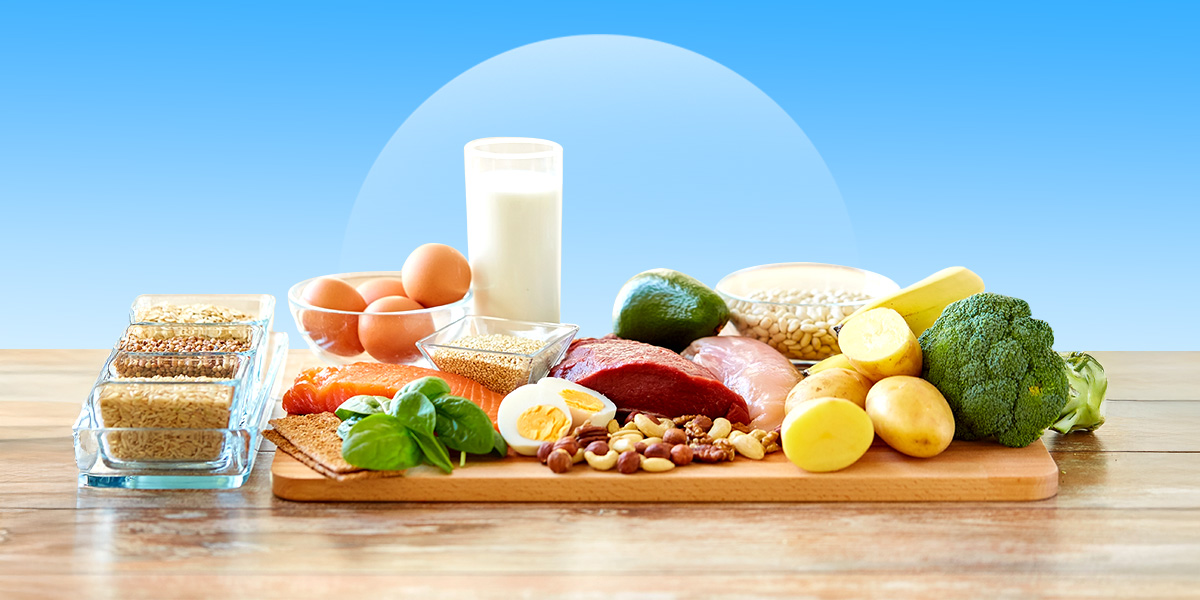
All you need is… protein? This macronutrient seems to be still trending across wellness and fitness communities, with social media influencers urging to up its intake.
But what are the key things you should know before jumping on the bandwagon?
-
Protein is a macronutrient made of amino acids, essential for various functions.
-
Depending on your goals and lifestyle, you may need between 0.8 grams and 2.2 grams of protein per kilogram of body weight.
-
Some scientists believe that not meeting protein needs may lead to overeating.
-
While protein is an important macronutrient, maintaining a varied diet is essential for overall health.
What is protein?
Protein is one of the macronutrients, along with carbohydrates and fats. It is made up of amino acids, some of which you need to get through a diet, while others can be produced by the body.
Protein is involved in various functions, including metabolism, hormonal signaling, and digestion. In other words, getting enough protein is essential, even if you’re not trying to increase your muscle mass.
How much protein do you actually need?
For the general population, the recommended dietary allowance (RDA) is 0.8 grams of protein per kilogram of body weight.
However, if you are active, it might not be sufficient. The American College of Sports Medicine (ACSM) recommends consuming more protein based on your goals.
For endurance athletes, the ACSM recommends 1.2–1.4 grams of protein per kilogram of body weight. This goal is based on two key factors. First, prolonged exercise increases protein oxidation, meaning the body breaks down more protein. Second, studies show that higher protein intake aids in recovery.
For strength athletes, the ACSM recommends 1.2–1.7 grams of protein per kilogram body weight. This higher intake is due to the increased demand for essential amino acids to support muscle growth, especially during the early stages of resistance training. Over time, individuals who regularly engage in resistance training may require slightly less protein to maintain muscle mass, as their bodies become more efficient at using protein.
When losing weight, you might also want to consume more protein than the RDA. Increased protein intake helps to prevent muscle mass loss, as weight loss does not come from fat loss alone. As research studies have shown, consuming around 1.6 grams of protein per kilogram of weight may be sufficient to minimize lean mass loss.
Protein leverage hypothesis
If your social media algorithm has noticed your fascination with fitness and wellness, you probably have heard that increased protein intake can support weight loss. This closely relates to the protein leverage hypothesis, which argues that humans are driven to eat until they meet their body's protein needs.
In other words, if the diet is low in protein, you may end up consuming more total calories in an attempt to reach your protein needs, even if you reach a caloric surplus.
Is this supported by science? Some research studies were conducted to test it out.
For instance, researchers of one relatively small experimental study divided participants into three different groups, each consuming diets with either 10%, 15%, or 20% of their calories from protein. When the diet had only 10% protein (less than usual), people consumed more calories overall, mostly from savory snacks between meals.
A similar study compared participant behavior based on their total protein intake. Three different groups were compared, each consuming either 5%, 15%, or 30% of their calories from protein. While the study does conclude that higher protein intake reduced overall caloric intake, lower protein intake did not lead to a significant increase in total caloric intake.
In other words, researchers are still determining whether the protein leverage hypothesis is well-founded and exploring just how big a role it plays overall.
So, should you focus on protein intake when losing weight?
If your overall goal is to lose weight, focusing on protein intake alone might not be enough.
Although protein (together with fiber) is what we call satiating nutrients, it is also recommended to avoid ultra-processed food, as it is linked to higher caloric intake.
“Unfortunately, the American diet tends to rely heavily on ultraprocessed foods, which are lower in protein and fiber but higher in calories (examples include chips, cookies, crackers, and candies). Consuming higher-calorie foods that don’t promote fullness will likely lead to eating again soon,” explains Emily Fisher, Registered Dietitian and Certified Personal Trainer.
“A study published in 2021 found that participants on a whole food, plant-based diet consumed fewer calories than those on a ketogenic diet, despite both groups eating similar percentages of protein (14.5% total calories). This study suggests that the foods we choose matter, not just the amount of protein we consume. A high protein diet isn’t always healthier, and low protein doesn’t automatically equal excess calorie intake,” adds Fisher.
So what works? “Prioritizing lean proteins with meals and snacks can support satiety and metabolism, making weight loss easier. Additionally, incorporating fiber-rich, lower-calorie foods such as fruits, vegetables, legumes, and whole grains can also support a healthy weight,” suggests Fisher.
Types of protein supplements: what you need to know
Although protein from whole foods is undoubtedly the best option, protein supplements can come in handy. With so many choices out there, how do you find your perfect match?

Whey protein
Whey protein, derived from milk, is a byproduct created during cheese production. But being a byproduct does not mean it is worthless — in fact, it is the most widely used protein supplement.
“Whey protein is a very fast-digesting type of protein supplement, and it’s ideal for post-workout recovery. It’s almost everyone’s go-to type of supplement, because it’s a complete protein and rich in leucine, excellent for building and recovering muscles,” shares Maria Vazquez, a NASM-certified Personal Trainer and Sports Nutritionist.
Casein protein
Also derived from milk as a byproduct, casein is a slow-digesting protein with a complete amino acid profile.
Its slow digestion provides a consistent release of amino acids over several hours. Casein is frequently used before sleep, whereas whey protein is preferred as a post-workout supplement.
Plant-based protein
Vegan protein options come from a variety of plant sources such as peas, rice, hemp, and more. However, many single-source plant proteins tend to have incomplete amino acid profiles, meaning they don’t provide all nine essential amino acids your body needs
To get around this, experts like Maria Vazquez recommend choosing blended plant protein powders. These blends combine different plant proteins to create a complete amino acid profile.
Collagen protein
Collagen supplements are usually used for different goals than traditional protein powders. The most well-researched benefit of this protein is skin health support. Joint health is also being studied, but to a lesser extent.
While collagen supplements might be promoted for weight loss, the truth is, collagen is not a complete protein, so it’s not the star player when it comes to this goal.
Protein myths
Protein is a shining star in the wellness community. While everyone is loud about it, not all things said on social media hold up under scrutiny.
Myth 1: Plant protein is incomplete
Some foods contain complete proteins, meaning they provide all nine essential amino acids, while others have incomplete proteins and only offer a few.
While it is true that certain vegan-friendly proteins are incomplete (e.g., lentils, beans, nuts), not all of them are. Complete plant-based proteins include soy products, buckwheat, and quinoa.
Besides that, it is not necessary to get all the amino acids in one single meal; thus, even if you consume incomplete proteins, you can still meet your amino acid needs following a varied diet.
Myth 2: You can only absorb around 20–30 g of protein per meal
Your body absorbs all the protein you eat, but there's a limit to how much is used for muscle protein synthesis at once, which stands around 20–40 grams per meal. The rest will be used for energy, just like fats or carbohydrates, or stored away.
However, the human body does not store protein as it does fat and carbohydrates. Thus, if consumed in excess, it is converted into other compounds, such as glucose or fat.
Myth 3: You need to track not only the protein but also the amino acids
Obsessively tracking each individual amino acid is not necessary for most people. If you are eating enough total protein from a variety of sources (especially if you include complete proteins), your amino acid needs will be covered naturally.
Unless you have a specific medical condition or follow a very restricted diet, focusing on overall protein intake is generally enough to support health.
Leucine, however, might be something to keep your eye on if you are trying to build muscle. This amino acid is essential for muscle protein synthesis, and it is commonly recommended to get at least 2–3 grams of it per meal.
Protein — the most important nutrient?
With so much talk about protein, it might seem that focusing on it is enough. This approach, however, could lead to several pitfalls.
For instance, the American Heart Association highlights that increasing protein intake may also raise the amount of saturated fat consumed, which might have a negative impact on cholesterol levels. Plus, some people end up cutting back on other important food groups (like fruits and vegetables) when they focus too much on protein.
You probably have heard this before, but the mantra of nutrition is simple enough: it is essential to maintain a well-rounded diet that includes a balance of all nutrients.
9 resources
- National Academies of Sciences, Engineering, and Medicine. Dietary reference intakes for energy, carbohydrate, fiber, fat, fatty acids, cholesterol, protein, and amino acids.
- American College of Sports Medicine (ACSM). Nutrition and athletic performance.
- Nutrients. Recent perspectives regarding the role of dietary protein for the promotion of muscle hypertrophy with resistance exercise training.
- Nutrients. Dietary protein and muscle mass: translating science to application and health benefit.
- The International Society of Sports Nutrition (ISSN). International Society of Sports Nutrition position stand: protein and exercise.
- PLOS One. Testing protein leverage in lean humans: a randomised controlled experimental study.
- The American Journal of Clinical Nutrition. Protein leverage affects energy intake of high-protein diets in humans.
- The Journal of Nutrition. Leucine regulates translation initiation of protein synthesis in skeletal muscle after exercise.
- Nature Medicine. Effect of a plant-based, low-fat diet versus an animal-based, ketogenic diet on ad libitum energy intake.






Your email will not be published. All fields are required.