One afternoon, I was browsing the dairy aisle of my local grocery store when I overheard a conversation between two women. They were standing in front of the milk section, deep in discussion about whether to choose whole or skimmed milk — and which one is considered ‘healthier.’
The debate sounded familiar, and as a nutritionist, I couldn’t help but pause. I realized that many people make daily nutrition decisions with good intentions, but, at times, with limited or outdated information.
The numbers on milk cartons might seem quite straightforward at first, but they often lead to confusion about what they mean in terms of health.
In this article, I will break down what the percentages on the milk packages really mean, whether there is such a thing as healthier milk based on its fat content, and how you should decide which milk to bring home.
-
For decades, whole milk has been vilified due to its higher saturated fat content. However, more recent research challenges its potential negative impact on health.
-
Skim milk is lower in total and saturated fat, and it may be higher in some vitamins and minerals compared to whole milk, which could be attributed to additional fortification.
-
Certain aspects, like protein or carbohydrate content, remain similar despite milk processing to remove fat content.
What are skim milk and whole milk?
Let’s start by saying that dairy products, or in this case, cow’s milk, in its ‘natural’ form — no matter if it’s whole, 2%, or skim — is incredibly perishable.
That’s because it’s the perfect environment for various bacteria and other microorganisms to grow. To keep it safe for consumption and fresh by the time it reaches the dairy aisle, milk goes through a carefully controlled process.
Once milk arrives at the processing plant from the local farms, it’s tested in the lab to make sure it meets strict quality and safety criteria. If it passes, it’s filtered to remove any impurities.
Then, the important step comes — the cream separator. This machine uses fast spinning to separate the milk’s fat from the liquid. Depending on how much fat is added back in afterward, we get varying milk fat percentages.
After that, the milk goes through additional processes like pasteurization and packaging until it reaches the grocery store shelves.
You might be thinking: why go through the trouble of removing the fat from milk only to add some of it back in later?
When milk is first separated, it becomes fat-free or what’s known as ‘base’ milk. From this point, processors gain full control over the fat content, allowing them to standardize the final product according to consumer preferences and regulatory labeling requirements.
Raw milk (unprocessed milk) usually contains around 3.5–5% fat content, but it can greatly vary between farms and cows. Thus, even whole milk goes through the same cream separator process, standardized to usually 3.25% fat or as defined by regulations.
Meanwhile, in low-fat or reduced-fat milk, the fat content may be limited to 1–2%, while skimmed milk usually contains only around 0.5% fat.
How do skim milk and whole milk compare nutritionally?
As a nutritionist, I always like to compare tangible examples in order to see whether, nutritionally speaking, there are any differences between dairy products, in this case, milk.
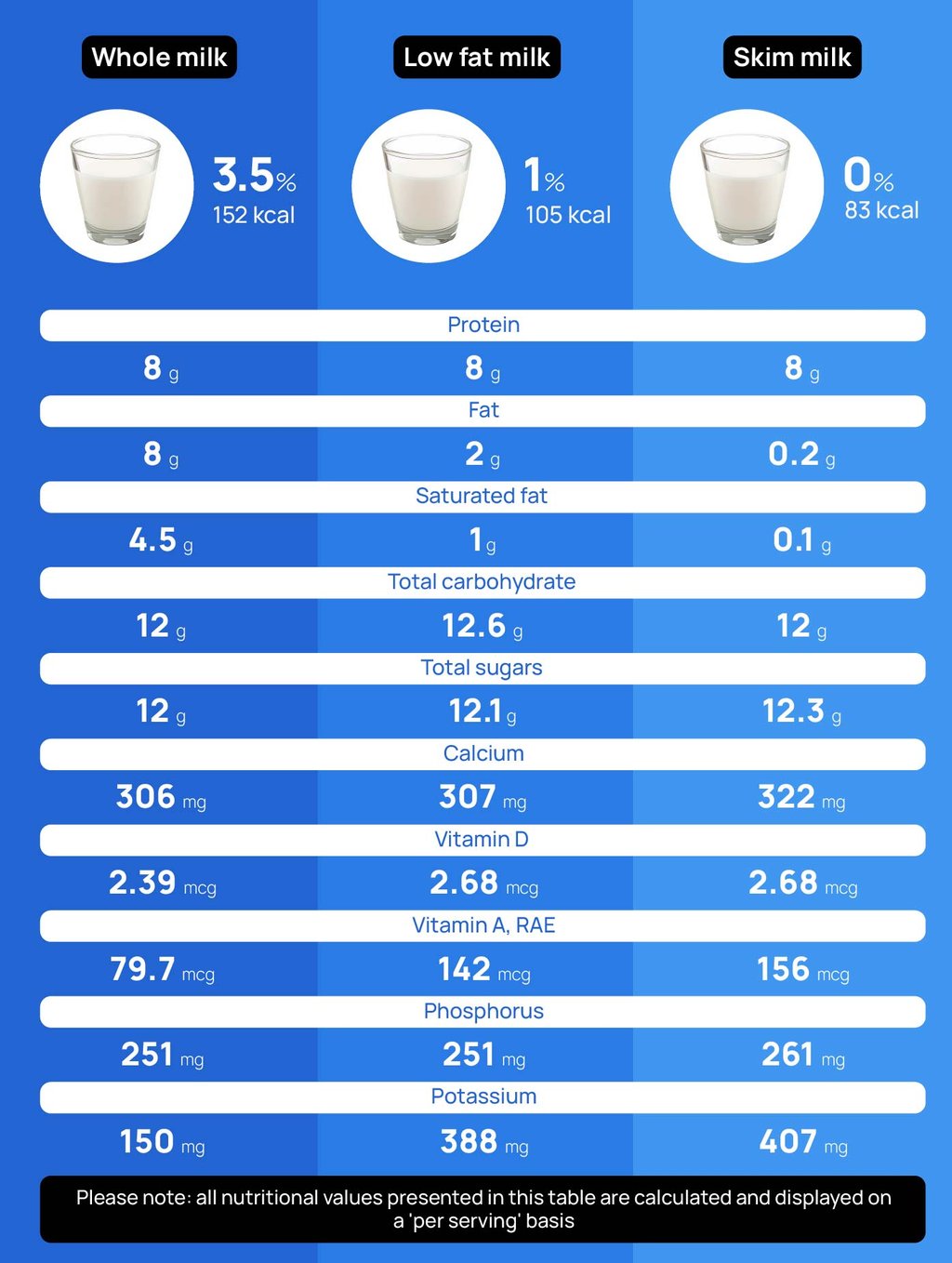
If we compare different types of cow milk per serving of one standard cup (240 ml/8 fl oz), we can see all types of milk, including whole milk, low-fat milk, and skimmed milk, contain the same amount of protein. That is because fat removal and further processing do not tend to meaningfully affect protein content.
Additionally, all types of milk contain relatively similar amounts of carbohydrates and total naturally occurring sugars like lactose. Lactose-free milk usually undergoes additional filtration and enzymatic treatments.
However, while both skim and whole milk come from the same source, their fat content creates some key differences, especially when we have calories, certain fatty acid content, and fat-soluble nutrients in mind.
The main differences between regular milk and reduced-fat milk are in their calorie content. Whole milk contains around 152 calories per serving of cup, meanwhile lower-fat milk contains around 105 calories, and skim milk contains only 83 calories per serving of cup.
Whole milk has a higher fat content, thus, it is also higher in saturated fats. Full-fat milk contains around 4.5 grams of saturated fat per serving of a cup, meanwhile skim milk contains only 0.1 grams of saturated fat.
Milk also contains vitamins and other nutrients that provide potential health benefits when consumed in adequate amounts. Milk is a good source of calcium and potassium, which are usually not affected by fat removal.
However, slight differences in these minerals can be noted between whole and skim milk, likely due to natural variability or additional fortification practices during processing.
On the other hand, certain fat-soluble vitamins like D or A, which milk is a good source of, may be lost during the fat removal process. These vitamins tend to be added back later, which is why some skim milk may contain more D or A vitamins compared to whole milk. For example, a cup of full-fat milk contains around 79.7 micrograms of vitamin A, while a cup of skim milk contains around 156 micrograms.
Finally, it is important to note that another common source of confusion appears in terms of organic or grass-fed milk versus conventional milk. While most nutrients between these types of milk remain quite similar, organic and grass-fed milk may contain more omega-3 fatty acids compared to conventional milk. However, these benefits are more related to full-fat milk options.
Why is whole milk considered less healthy?
The ‘milk debate,’ particularly in terms of whole milk, has evolved over the past several decades, reflecting shifts in scientific understanding, public health policies, and even consumer preferences.
The main type of dietary fat in cow’s milk is saturated fat, though it also contains small amounts of monounsaturated and polyunsaturated fats, as well as naturally occurring trans fats (not the ‘harmful’ industrial type).
The debate started somewhere around the early 1960s when the American Heart Association recommended reducing saturated fat intake, including sources such as full-fat dairy, due to potential concerns about the link between saturated fat and increased risk of heart disease, as early research suggested.
The most well-known study that had an impact on these recommendations was a 15-year follow-up of the Seven Countries Study, where analysis revealed that death rates were positively associated with the percentage of dietary energy from saturated fats. The highest percentage in the analysis was attributed to mortality rates due to cardiovascular disease.
Some resources speculate that such recommendations may have also been influenced by funding from companies producing vegetable oils, which were offered as a ‘healthier’ alternative.
Since then, low-fat dairy products have been recommended in most dietary guidelines. Full-fat dairy consumption has decreased in favor of low or non-fat dairy options. The food industry has also modified dairy formulas by mainly increasing sugar content to make these products more palatable.
What does recent research say about dairy fat and health?
While earlier studies linked saturated fat intake with increased LDL cholesterol or higher heart disease risk, recent studies suggest that the relationship is more complex.
Now, the common understanding is that the health impact of saturated fat appears to depend on the food source of dietary fat and overall dietary pattern. For instance, saturated fat from whole dairy products may not have the same exact effect as that from red meat.
While researching for more information about this ongoing milk debate, I stumbled upon a YouTube video from an athlete, lifestyle, and nutrition coach. In the video, Andrew Tunstall talked about saturated fats and health: “Since the 70s, we believed that saturated fat causes heart disease, and almost 50 years later, the belief is still here.”
As a matter of fact, recent studies suggest that high dairy intake, despite its fat content, showed no detrimental effects on outcomes like blood lipids (fat) or blood pressure. Moreover, research suggests that full-fat dairy may increase HDL cholesterol compared with a controlled diet. This means that choosing whole milk as an occasional drink may not have a long-term negative impact as previously assumed.
As a nutritionist myself, I always emphasize that the key to saturated fat and overall fat intake is balance. Different food sources containing saturated fat may have varying effects on health.
While full-fat dairy has some saturated fats, it also has a complex nutrient matrix, including protein, vitamins, and minerals. For comparison, if we take highly processed foods like baked goods, we’ll often find a higher added sugar content alongside saturated fats and minimal desirable nutrients to support health.
In any case, while the evidence suggests that eliminating full-fat dairy may not be necessary in order to maintain heart health, more research is needed to understand this delicate link between saturated fats in milk and overall health support.
What are the current dietary guidelines for dairy and fat?
The recommended daily intake of total fats from dietary sources is around 20–35% of total calories. Meanwhile, saturated fats should be no more than 10% of total daily calories.
Currently, the Dietary Guidelines for Americans focus on maintaining the daily dietary balance of the type of fat consumed from various sources while emphasizing the intake of ‘healthy fats’ like monounsaturated and polyunsaturated fats.
Some fat sources include:
- Olive oil
- Nuts
- Seeds
- Fish
- Avocados
Regarding milk, the Dietary Guidelines suggest that a healthy dietary pattern features dairy, including fat-free, low-fat, or skim milk options. The guidelines encourage drinking skim milk with meals or incorporating it into breakfast and snacks.
However, there seems to be certain potential updates regarding saturated fats in the upcoming American Dietary Guidelines of 2025–2030.
The advisory committee proposes that the Guidelines should focus more on comparing the impact of saturated fats from different food sources, rather than suggesting the overall limitation of saturated fats from all sources.
However, the new dietary guidelines are only on their way, so whether we will see any potential changes in the recommendations is yet to be determined.
Which type of milk should you choose?
So, now that we have uncovered all there is behind the ‘milk debate,’ it is worth saying that the right type of milk for you depends on a variety of factors and personal preferences.
There is no one kind of inherently ‘bad’ or ‘good’ milk type for everyone. Your overall diet, lifestyle, personal health goals, and even aspects such as taste preference or the amount of milk you consume per day play a much bigger role in determining which milk fits best into your routine.
If you enjoy the creamy taste of whole milk and don’t have specific health concerns, then full-fat milk can be a great option. On the other hand, skim milk offers fewer calories and almost no fat, making it a sensible choice if you are trying to limit your dietary fat intake due to certain health conditions or weight goals.
Also, people who are lactose intolerant may opt for lactose-free milk, while others may choose grass-fed or organic milk options due to personal preferences.
In any case, it is important to remember that saturated fat in milk is just one small part of your entire diet. Usually, it's not about limiting or avoiding a single food item but managing overall eating habits by focusing on nutrient-rich whole foods rather than highly processed ones.
Final thoughts
Whole milk and other full-fat dairy products gained a bad reputation throughout several decades for potentially negatively affecting heart health. However, recent findings suggest that it may be a bit more complicated than that, and not all saturated fats from all food sources are equal. While more research is needed to fully understand the impact of whole milk or skimmed milk on health, it is clear that for most people, whole-fat dairy products can be a part of a healthy and balanced diet.
FAQ
What is better for you, skim milk or almond milk?
There is no one-size-fits-all option for everyone. Skim milk tends to have a higher protein content, naturally contains calcium, and is usually fortified with vitamins A and vitamin D. Meanwhile, almond milk is a naturally lactose-free option that can also be fortified with certain nutrients and may contain a similar or lower calorie content. However, it is usually lower in protein — the specifications rely on the fortification and the brand.
Why are doctors changing their minds about whole milk?
Health experts always remind us that overall nutritional quality matters more than fat content alone. Many doctors are shifting from nutrient-specific advice and instead highlighting that overall eating habits and a balanced diet have the most impact on health. There are also suggestions that saturated fats in certain foods like dairy products, especially milk, may not have such meaningful health effects, so they can definitely be a part of the overall dietary pattern.
Is it okay to drink whole milk every day?
For most healthy people, it’s perfectly okay to include whole milk in their daily routine, as whole milk isn’t inherently ‘bad’ — it can provide certain vitamins, minerals, protein, and other nutrients the body requires every day. Just be mindful of the portion sizes to align the intake with your dietary pattern and personal health goals.
16 resources
- Food and Agriculture Organization of the United Nations (FAO). Gateway to dairy production and products.
- Food and Agriculture Organization of the United Nations (FAO). Dairy products toolkit.
- Food and Agriculture Organization of the United Nations (FAO). Milk.
- U.S. Food and Drug Administration (FDA). Raw milk misconceptions and the danger of raw milk consumption.
- National Academies Press. Market implications of changing the fat content of milk and dairy products.
- National Agency for Food and Drug Administration and Control Act 1993. Milk and dairy product regulations 2005.
- Indian Institute of Crop Processing and Technology. Lactose-free milk production.
- Food Chemistry. Fat-soluble vitamin contents and fatty acid composition in organic and conventional Italian dairy products.
- Public Library of Science ONE. Organic production enhances milk nutritional quality by shifting fatty acid composition: a United States-wide, 18-month study.
- Journal of Dairy Science. The composition of milk fat.
- Journal of Current Opinion in Endocrinology, Diabetes, and Obesity. A short history of saturated fat: the making and unmaking of scientific consensus.
- The American Journal of Epidemiology. The diet and 15-year death rate in the Seven Countries Study.
- Foods. Dairy fat and cardiovascular health.
- Advances in Nutrition. Effects of dairy intake on markers of cardiometabolic health in adults: a systematic review with network meta-analysis.
- USDA. Dietary Guidelines for Americans 2020-2025.
- USDA. Scientific report of the 2025 Dietary Guidelines Advisory Committee.






Your email will not be published. All fields are required.