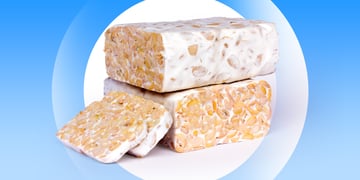
Chicken, lean beef, salmon, and chickpeas are common choices when you want to increase daily protein intake. They are reliable, familiar, and easy to add to meals.
However, sticking to the same foods can make your diet feel repetitive. What if there were another protein-packed option that is nutritious, versatile, flavorful, and often overlooked in Western diets?
In that case, we would like to represent tempeh, a fermented soybean product from Indonesia and a staple of Southeast Asian cuisine. Whether you eat plant-based, want to reduce meat, or simply want to diversify your meals, tempeh could be a great option.
That is why, in this article, we explore the nutritional and health benefits of tempeh and why you should try it.
-
Studies confirm the health benefits of regular tempeh consumption, including possible reduced risk of cardiovascular problems, improved cognitive function, and anti-aging effects.
-
Neither soy products nor isoflavone supplements negatively affect male reproductive hormones.
-
Steaming tempeh helps to remove bitterness and opens the pores, allowing marinades to be fully absorbed.
How is tempeh made?
The tempeh-making process has a few stages. First, soybeans are soaked overnight for at least eight hours. Once softened, the hull is removed, and the beans are boiled for 30–60 minutes. After boiling, excess water is drained, and the beans are dried with a towel to prevent improper fermentation.
When cooled, they are placed on a tray and mixed with Rhizopus oligosporus mold. The beans are then left to ferment at 85–90°F (29–32°C) for 24–48 hours. During fermentation, white mold mycelium covers the beans and binds them into a solid sheet. The tempeh sheet is cut into smaller pieces and sold that day, because it has a short shelf life.
Tempeh is usually prepared by frying, deep-frying, or baking. It is also added to soups, fast foods, and used as a meat replacement.
Why is tempeh considered a superfood?
As Functional Medicine Nutritionist Jordan Casey says, tempeh has earned the title of a superfood for its wide array of health benefits across various body systems.
“Tempeh is rich in calcium, magnesium, phosphorus, manganese, and B vitamins. Ensuring adequate long-term intake of vitamins and minerals is associated with a number of health benefits,” he explains. He adds that a review article in Future Foods highlights studies confirming the health benefits of regular tempeh consumption. These benefits may be:
- Antidiabetic properties
- Cholesterol-lowering effects
- Improved cognitive function
- Anticancer activity
- Anti-aging effects
- Reduced risk of cardiovascular problems
Furthermore, the review highlights that microbes from fermentation may act as probiotics or prebiotics, supporting gut health and enhancing nutritional value. “Fermenting also helps break down phytic acid, making the nutrients within tempeh more bioavailable,” adds Casey.
Phytic acid is a natural compound found in plant seeds, nuts, grains, and legumes. It can block mineral absorption by binding to them and making them harder for the body to use. “Fermentation reduces this in plant foods, making the food far more nutrient-dense,” sums up Casey on how tempeh becomes a superfood.
Tempeh and tofu comparison
According to Casey, tempeh is a complete plant-based protein that contains all nine essential amino acids. “Its protein content is higher than any other plant-based protein, making it an efficient and easy addition to a plant-based diet,” compares Casey.
Food Scientist Brian Chau agrees, explaining that tempeh contains more protein due to the fermentation process. He also emphasizes that tempeh is low in sugars, as the fermentation process converts sugars into other compounds, and is naturally low in fat.
Therefore, we decided to compare one of the most widely used plant-based proteins, tofu, with tempeh to see whether tempeh is actually more nutritious. Use the following table for nutrition comparison of 4 oz (112 g) of each product:
| Tempeh | Tofu | |
| Calories | 215 | 87 |
| Protein | 22.7 g | 10.1 g |
| Carbohydrates | 4.2 g | 2 g |
| Fat | 12.1 g | 4.7 g |
| Fiber | 4.1 g | 1 g |
| Calcium | 12% of DV | 23% of DV |
| Iron | 17% of DV | 10% of DV |
| Potassium | 18% of DV | 6% of DV |
| Magnesium | 29% of DV | 13% of DV |
*The numbers are estimated. Even in databases such as USDA and NCCDB, you will find slightly different proximates.
Soy feminization myth
These days, the internet is a wild place full of information, and sometimes it can be misleading. If you look through Instagram, TikTok, or other social media sites, you might notice a trend that encourages men not to consume soy products. The claim is that men who eat soy will be ‘feminized’: their testosterone will drop, estrogen will rise, and they will grow breasts.
Chau thinks this is happening because of misaligned research and malicious marketing by non-soy groups to increase the consumption of non-soy products. He explains that the culture around manliness uses toxic masculinity and racism to target men who drink soy milk or eat tofu, tempeh, or other soy products, because soy isoflavones are similar to estrogen as a class of compounds (phytoestrogens).
“Furthermore, the term ‘soy boy’ is held to be derogatory to discourage consumption of soy. The U.S. soy farming is often GMO and sold as animal feed, biofuel, or other types of products, which many farmers do not believe is suitable for human consumption,” he adds.
Studies try to debunk this myth. For example, a 2021 meta-analysis examined whether eating soy foods or soy isoflavones affects male reproductive hormones. Researchers analyzed data from 41 clinical studies involving adult men and evaluated their hormone levels.
They found that neither soy products nor isoflavone supplements had any effect. The findings were consistent regardless of how much soy was consumed or for how long.
“Xenoestrogens such as microplastics, phthalates, and parabens in plastics, cleaning, and personal care products are far more harmful to our hormones than naturally occurring phytoestrogens,” sums up Casey and adds that phytoestrogens have been shown to support hormone function. “Estrogen is also an essential hormone for men as well,” he clarifies.
How to prepare tempeh?
Tempeh is often considered hard to prepare because it has a naturally bitter taste, and some people find it ‘funky’ when raw. Its dry, dense texture means tempeh needs strong marinades to absorb flavor.
Still, you shouldn’t be discouraged from adding tempeh to your meals just because it takes a little extra preparation. We recommend doing some online research and experimenting in the kitchen to find what works for you.
For example, take advice from Chef Claire Sharryn Roberto. She suggests that steaming is the secret to a delicious tempeh. It helps to remove bitterness and opens the pores, allowing marinades to be fully absorbed.
For more inspiration, we will also share recipe video here.
Bottom line
If you are tired of your usual protein choices and want to diversify your meals, adding tempeh can be a great solution. It is packed with vitamins and minerals. It may take some time to master its preparation, but once you do, it’s worth the effort.
While tempeh offers health benefits, such as improved cognitive function, it’s important to maintain a balanced diet by including a wide range of produce.






Your email will not be published. All fields are required.