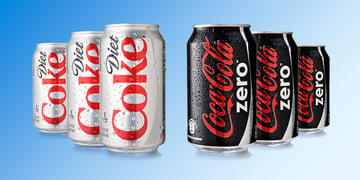
Diet Coke, launched in 1982, defined several decades as the drink of choice of the cool girls. It has been featured in movies and is enjoyed by those trying to reduce sugar, lose weight, or enjoy the taste equally. The silver can with red letters remains iconic to this day.
In 2005, Coca-Cola launched another zero-sugar, zero-calorie drink: Coke Zero. Allegedly, because Diet Coke had been marketed for women for so long, it became associated with being a feminine drink, and the company wanted to attract the male audience. Officially, Coke Zero tastes closer to the classic, full-sugar Coke.
Let’s dive into the nutritional differences between the two. Is one of them better and healthier, and is the taste truly different, or is it in our heads?
-
Diet Coke and Coke Zero are zero-sugar, zero-calorie drinks primarily sweetened with aspartame.
-
Diet Coke is an older product with a slightly lighter citrusy taste, while Coke Zero is a closer replica of the original Coca-Cola.
-
Coke Zero additionally contains acesulfame potassium and stevia as sweeteners, but it does not make it more or less healthy.
Overview of each product
Let’s compare the two drinks in more detail to understand the history, marketing, and intended audience.
Diet Coke
Launched in 1982, Diet Coke was Coca-Cola’s first new brand since 1886, using the official trademark and reflecting the period of change. The sugar-free, low-calorie soft drink in a sparkling silver package with iconic red letters quickly distinguished itself as a groundbreaking launch in the beverage industry.
The creator team considered calling it ‘sugar-free,’ but felt it was a slur to the main ingredients in Coca-Cola, while the label ‘light’ was already taken by a competing brand. Interestingly, for years it was ‘diet Coke,’ with a lower case, because Coca-Cola’s lawyers argued using an upper case would make ‘Diet’ a noun, hence changing the name of the trademark.
It was initially aimed at baby boomers who were getting older and heavier and developing health problems that required them to cut calories and sugar. At the time of development, the FDA had only approved sucralose as a sweetener, but the team at Coca-Cola believed that by the launch year, aspartame would also be FDA-approved. They were correct — this risk allowed them to get ahead of competitors and dominate the market. The dramatic and slightly exclusionary launch, fuelled by gossip in the Big Apple, guaranteed its popularity.
By the end of 1983, Diet Coke was the number one diet soft drink in the U.S. and the top soft drink choice among women. From then on, the marketing campaign used glamorous female celebrities, subtly whispering a promise of a slim and fit physique if you opt for this drink, neatly fitting into the rising diet culture. The association was so deep that Diet Coke became associated with the ‘cool, career-driven, effortlessly slim, and glamorous’ woman ideal.
The marketing also focused on taste. It is distinct from the original Coca-Cola and has a lighter, crispier taste with undertones of citrus. It was not designed to mimic the original flavors; instead, it is “a great-tasting soft drink that happens to have one calorie, rather than a diet drink that tastes great,” according to Steve Norcia, who was part of the team that created Diet Coke.
In Europe and some other regions, the drink is called Coca-Cola Light, as the word is more widely associated with drinks, while the word ‘diet’ is usually reserved for low-calorie food. Furthermore, it is not as widely available as in the U.S. due to a preference for Coke Zero.
Coke Zero
Fast-forward to 2005, Coca-Cola launched Coke Zero, which was rebranded to Coca-Cola Zero Sugar in 2017. This groundbreaking product was supposed to deliver the iconic taste of the original Coca-Cola with zero calories and sugars.
Although not mentioned by the company for obvious reasons, many believe that Diet Coke’s history of marketing for women and primarily a female audience prompted the development of this product to appeal to a broader audience. It also resonated with the rise in health and wellness culture, with people cutting down on sugar not just for dieting reasons.
Coke Zero's marketing focused heavily on recreating the classic Coca-Cola flavor experience without sugar, using bold, contemporary campaigns like #TakeATaste and partnerships with brands and events popular among young adults. This time, it took all platforms by storm, including social media.
Coke Zero matches the flavor and visual packaging of the original product; it just uses black rather than white letters, unlike Diet Coke, which is a unique product on its own.
Ingredients and nutritional comparison
For the sake of simplicity, let’s put all the spin-offs like Lemon Coke Zero aside and compare the two original products from a nutritional standpoint. The taste can differ by region, as Coca-Cola states that the sweetness varies depending on the area.

I asked Avery Zenker, a Registered Dietitian with a Master's in Nutrition, to explain the ingredients.
Diet Coke and Coke Zero have very similar ingredients, with a few differences. Coke Zero replaces citric acid with potassium citrate and adds acesulfame potassium (also known as Ace-K, another artificial sweetener alongside aspartame) and stevia extract (a more natural sugar-free sweetener), which was only recently added to the ingredient list.”“Both drinks contain zero calories, sugar, fat, and carbohydrates, and a small amount of sodium (40 mg). They don’t contribute any macronutrients and have little to no micronutrients. Diet Coke has more caffeine (46 mg) than Coke Zero (34 mg) per 12-ounce can. For reference, the recommended maximum is 400 mg of caffeine per day. Coke Zero has more phosphorus (54 mg vs. 27 mg in Diet Coke), which is a mineral that comes from the phosphoric acid in Coke. Coke Zero contains potassium citrate (60 mg per can); this is generally not present in Diet Coke.
Avery Zenker
Despite having very similar nutritional profiles, these two drinks may affect the body slightly differently. Zenker says, “It’s possible that the differing ingredients could impact health in different ways. So far, there’s no strong data to indicate so for Diet Coke and Coke Zero.
Choosing Diet Coke would avoid the consumption of the artificial sweetener Ace-K, but it may also contain higher amounts of aspartame.”
However, later, she added that “Current evidence does not indicate that either aspartame or Ace-K is necessarily worse for health than the other, so we may not be able to draw strong conclusions about choosing Diet Coke or Coke Zero based on sweetener data alone.”
Health considerations
Coke does not claim to be a healthy drink, but given how widely its products are consumed, let’s examine the potential health impact.
Cancer
Both Diet Coke and Coke Zero use aspartame as a primary sweetener. Despite being one of the most studied and widely used food additives, aspartame has been an object of health debates for many years.
In 2023, the World Health Organisation (WHO) and the International Agency for Research on Cancer (IARC) classified aspartame as possibly carcinogenic to humans (2B group). This obviously scared a lot of people, despite both bodies stating that the evidence is limited and based on animal research, where they were fed enormous quantities of aspartame.
It is essential to understand that the classification is based on whether something can cause cancer rather than how likely it is to cause cancer. The 2B category is generally used when there is limited unconvincing evidence in humans or convincing evidence in lab animals, but not in both.
The FDA directly disagrees with the carcinogenic claims and reaffirms that aspartame is safe to use at 50 mg per kg of body weight, while the Joint FAO/WHO Expert Committee on Food Additives (JECFA) and European Food Safety Authority (EFSA) suggest a slightly lower limit of 40 mg per kg of body weight.
Zenker puts this into perspective: “A typical can of Diet Coke (which contains aspartame only) has about 180 mg of aspartame per 12-oz can. A typical can of Coke Zero (which contains both aspartame and Ace-K) contains approximately 46 mg of Ace-K and about 125 mg of aspartame per 12-oz can.”
So, for someone weighing 60 kg, about 17 cans of Diet Coke per day would reach the upper ADI limit for aspartame, and about 20 cans of Coke Zero per day would reach the upper ADI limit for Ace-K.
Zenker added that apart from aspartame, caramel color, which gives Coke its brown pigment, also raises some concern.
While it has been generally recognized as safe for consumption, certain types can contain 4-methylimidazole (4-MEI), a byproduct that has been linked in high doses to cancer in animal studies. Regulatory bodies like the FDA and Health Canada state that the levels found in soft drinks are far below what’s considered risky for humans, but there’s also conflicting evidence that suggests avoidable exposure to a potential carcinogen should be minimised.
Avery Zenker
Gut health
Despite what some wellness influencers say, little scientific evidence shows that non-nutritive sweeteners negatively impact gut health.
A meta-analysis found that daily aspartame oracesulfame-K consumption in healthy adults had no significant effects on gut microbe abundance or composition.
Aspartame, acesulfame-K, and saccharin are mostly fully absorbed in the colon and excreted in the urine, with only a negligible amount reaching the gut. However, people who have irritable bowel syndrome or other digestive diseases may be more sensitive to artificial sweeteners (as well as carbonated drinks and caffeine) and experience digestive issues.
Teeth damage
Most of us have heard as kids that sugar can damage teeth and erode tooth enamel. Some of us may have even been lucky enough to have been shown photos of rotten teeth as a warning against sweets.
Unfortunately, Zenker says phosphoric acid, which is present in higher amounts in Coke Zero, is also concerning. She explains, “Coke’s tangy flavor partially comes from phosphoric acid, which drops pH to roughly the 2.5–3.0 range, which is acidic enough that frequent intake can erode tooth enamel even without sugar. Some concern has been raised for the impact of phosphoric acid on dental health, bone health, and kidney health in those with kidney disease.”
The key concerns here are frequent use and improper mouth hygiene. A study compared the percentage of adults with tooth erosion and found that the group who consumed the most diet drinks had the highest rate of dental problems, but this was not statistically significant compared to the high water, coffee, tea, or regular soda consumption groups.
Cardiovascular and metabolic risk
Some studies have suggested that artificial sweeteners may be linked to cardiovascular disease and metabolic risk; however, many studies did not find any correlations. There is a lack of consensus on whether artificial sweeteners have such effects.
For example, the Framingham Heart Study found an association between diet soda consumption and unfavorable cardiac remodeling, which was not seen in those consuming regular soda. However, when adjusted for weight, the study concluded that the association is more likely due to higher body weight than soda consumption.
An observational study of over 5,000 U.S. adults found that regular diet soda consumption was associated with increased risk of developing metabolic syndrome and type 2 diabetes compared to non-consumers. Risk for type 2 diabetes remained significant even after accounting for body weight and waist circumference, while the link to metabolic syndrome was mainly explained by increased adiposity. Among the metabolic syndrome components, diet soda intake was significantly associated only with high waist circumference and fasting glucose development.
The study hypothesises that artificially sweetened drinks may increase cravings for sweet or energy-dense foods. Still, it clarifies that the research does not support the direct causation between artificial sweeteners and weight gain.
Neither Diet Coke nor Coke Zero is healthy, and their only benefit is helping to reduce added sugar. However, they should still be consumed only occasionally and in moderation. Despite being safe to consume, artificial sweeteners are still relatively new in the food industry and do not have health benefits.
Caffeine
Surprisingly, many people are unaware that all types of Coke contain caffeine. Nowadays, though, a caffeine-free version is available.
A 12-oz can of Diet Coke has 46 mg, and Coke Zero has 34 mg, which is about half an espresso shot. People who are sensitive to caffeine or are trying to limit it may find even this amount stimulating or find that it makes them anxious or jittery.
Caffeine is generally okay for adults, as long as it is not more than 400 mg daily. However, Coca-Cola is consumed by kids, too, who are not advised to consume caffeine.
Popularity
Regarding popularity, the opinions vary, with many reviews pointing to a generational split. Older generations tend to favor Diet Coke for its classic and lighter flavor. Younger generations who had Coke Zero growing up tend to favor it over Diet Coke. Coke Zero is also preferred by those who want a closer match to the original.
Nevertheless, both drinks are still leaders in soda sales in the U.S., and there is no current plan to discontinue either product.
I once saw a creator say Diet Coke is for those who genuinely enjoy its taste, and Coke Zero is for those looking to replace the real thing. I do agree with this, but we also have to keep in mind that after Coke Zero became available, it became the default choice and often more widely available in restaurants and stores. Likely, the younger generation that did not grow up with Diet Coke usually does not even get what the whole debate is about.
Bottom line
Regarding ingredients and health impacts, Diet Coke and Coke Zero are pretty close matches. Neither is healthy, as they offer almost no nutrients, but they are better than the full-sugar alternative.
The fearmongering around artificial sweeteners and other ingredients stems mainly from animal studies that link them to cancer, weight gain, or disrupted gut health. However, all ingredients in Coke comply with the safety regulations, and no studies have shown that artificial sweeteners directly cause health issues. There is some association with the consumption of diet drinks and high body weight, but it is not causational, and weight gain likely happened before switching to sugar-free drinks.
Lastly, keep in mind that lab animals are overfed the ingredients being studied, and it would be pretty hard to overconsume aspartame or other sweeteners present in Coke. You would need to drink over 15 cans of Coke every single day to reach the upper limit of the recommended daily limit.
So, when it comes to Diet Coke versus Coke Zero, pick the one you prefer: the lighter version or a replica of the original recipe.
FAQ
Is it safe for people with diabetes to drink Diet Coke or Coke Zero?
Both drinks are free of sugar and calories and should not raise blood sugar, so they are considered safe for people with diabetes. However, always check with your healthcare provider about any diet changes.
Does drinking Diet Coke or Coke Zero break a fast?
Technically, both have zero calories, so they generally will not break a typical caloric fast. However, some people prefer to avoid everything other than water, black coffee, or unsweetened tea.
Are there known environmental or ethical differences between Diet Coke and Coke Zero?
No significant differences exist in environmental impact or ethical sourcing between the two; both are produced by Coca-Cola and follow the company’s sustainability policies.
11 resources
- The Coca-Cola Company. The extraordinary story of how Diet Coke came to be.
- The Coca-Cola Company. Diet Coke.
- The Coca-Cola Company. Coke Zero.
- World Health Organisation. Aspartame hazard and risk assessment results released.
- FDA. Aspartame and other sweeteners in food.
- American Cancer Society. Aspartame and cancer risk.
- Nutrients. Effects of non-nutritive sweetener on the gut microbiota.
- Sage Journals. Dental erosion: effect of diet drink consumption on permanent dentition.
- Metabolism. Association of soda consumption with subclinical cardiac remodeling in the Framingham Heart Study.
- Diabetes Care. Diet soda intake and risk of incident metabolic syndrome and type 2 diabetes in the multi-ethnic study of atherosclerosis (MESA).
- FDA. Spilling the beans: how much caffeine is too much?
Your email will not be published. All fields are required.