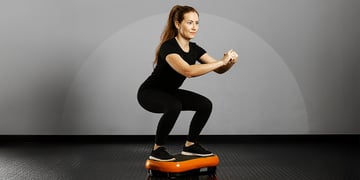
Not going to lie, new health tech excites me more than it probably should, as it is usually expensive and borderline gimmicky. But count me in, I will try it if I have a chance, even if it feels a bit cringe-worthy. That’s exactly how I felt about vibration plates at first.
In fact, these rather new devices gave me flashbacks to the mid-2000s and those vibrating belts that promised effortless weight loss. (Plot twist: those didn’t work, obviously.) So naturally, I had to ask: do vibration plates work, or are they just another trendy fad?
As it turns out, vibration plates are a bit more sophisticated and actually somewhat backed by science. While the emphasis is definitely on somewhat, early research does look promising.
-
Vibration plates may engage your muscles more when combined with active exercises like squats and planks.
-
Early studies suggest that using vibration plates might be beneficial for bone health.
-
Some indications using vibration plates might also benefit brain health, but studies show mixed results.
-
Vibration plates are not safe for people with certain health conditions.
Vibration plates for your fitness goals
When I’ve heard about workouts with vibration plates, my first thought was that it sounded like another too-good-to-be-true trend, but it seems they can have their place in fitness.
Standing on a vibrating surface may help improve circulation and balance, which can be valuable for those looking to maintain mobility and prevent falls. However, if you want to get the most out of vibration plates, it’s not just about standing still.
As Dr. Leah Verebes, DPT, and Touro School of Health Sciences professor, explains, “Incorporating exercises such as squats, lunges, planks, push-ups, and core workouts enhances results by engaging more muscle groups and boosting calorie burn. Actively moving while using the plate maximizes its benefits, even though simply standing on it can support circulation and balance.”
So, vibration plates may challenge your muscles more effectively when combined with dynamic movements, making them a possible addition to a broader fitness plan.
Since I lift weights, however, vibration plates just did not seem good enough as a replacement. After all, lifting weights is effective in muscle building, especially combined with progressive overload, which is not easily achieved without weights.
So, are there any other benefits of vibration training?
Vibration plates for bone health
I hit the age when ‘bone health’ suddenly sounds exciting. Not that I am dealing with osteoporosis yet, but knowing that we typically hit peak bone density around 30, and that it’s downhill from here… yeah, no, sign me up for anything that can reduce the slope of that decline, thanks.
And, it seems, vibration plates could be something worth looking into for bone health.
As indicated in research studies, vibration plates may improve bone mineral density. The mechanism of action involves mechanical stress on bones from low-impact, high-speed vibrations, as explained by Dr. Leah Verebes.
“While standing, sitting, or exercising on the vibrating surface, the body experiences consecutive muscle contractions and small forces simulating the reactions to weight-bearing activities. These vibrations induce osteoblasts, known as cells which build bones, and activate bone tissue remodeling and solidification,” she further said to WellnessPulse readers.
Additionally, the muscle action caused by vibrations enhances balance and coordination, helping to prevent falls and fractures, which can be especially important for those with osteoporosis.
Are vibration plates good for your brain?
While the benefits for muscles, balance, and bones may not seem surprising, claims regarding brain health can initially sound far-fetched. However, scientists are, in fact, exploring the potential of vibration plates for brain health.
Early research indicates that using these plates might influence various inflammatory biomarkers, neurotransmitters, and brain-derived neurotrophic factor (BDNF). This means that vibration plates may help regulate brain inflammation, support nerve cell growth and repair, or improve communication between neurons.
While these effects may contribute to better cognitive functions, more research is needed to understand them. Right now, evidence is limited by inconsistent protocols and small, diverse study populations. Besides that, the results are mixed, with some studies showing no benefits.
Are vibration plates safe?
While vibration plates are considered relatively safe, some people are better off avoiding using them.
“Vibration plates shouldn't be used by anyone with cardiac or circulatory disorders, such as deep vein thrombosis (DVT) or pacemakers; pregnant women; people who have just had surgery; and people who have severe osteoporosis,” says Dr. Leah Verebes.
“People with pre-existing disorders, including herniated discs, joint issues, or acute inflammation, may experience worsening symptoms when using vibration plates. The vibrations may also be disconcerting to people who have inner ear problems or balance abnormalities,” she warns.
Bottom line
Vibration plates can support balance, but to truly challenge your muscles and boost results, you need to move. Adding exercises like squats and planks makes all the difference. They’re a helpful tool, not a replacement for real workouts.
Their advantages are linked to other potential benefits, such as bone and cognitive health support. However, studies on these benefits are still in very early stages, so do not rely on vibration plates as your main fitness tool.
FAQ
Are vibration plates good for lymphatic drainage?
It might. Research suggests that vibration plates may support lymphatic drainage by improving circulation and stimulating muscle contractions. However, more studies are needed to understand the effects.
Are vibration plates good for cellulite?
They might be, as indicated by early studies. Vibration therapy may help reduce cellulite by boosting blood flow and skin temperature, but more research is needed to confirm this.
5 resources
- Frontiers in Neurology. The effects of whole-body vibration therapy on immune and brain functioning: current insights in the underlying cellular and molecular mechanisms.
- Malaysian Journal of Medical Sciences. Role of the whole body vibration machine in the prevention and management of osteoporosis in old age: a systematic review.
- Frontiers in Neurology. The effects of whole-body vibration therapy on immune and brain functioning: current insights in the underlying cellular and molecular mechanisms.
- Medical Science Monitor. The effect of whole body vibration on lower extremity skin blood flow in normal subjects.
- Evidence-Based Complementary and Alternative Medicine. The impact of vibration therapy interventions on skin condition and skin temperature changes in young women with lipodystrophy: a pilot study.




Your email will not be published. All fields are required.