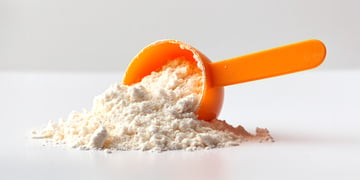
Dry scooping once defined GymTok and Instagram, but now the keyword is banned due to health risks associated with it. Initially, people took a scoop of pre-workout directly without mixing it with water. Later, many started doing the same with creatine and even BCAAs.
Consuming supplements in such a way offers no legitimate benefits, so why do people keep doing it, and how bad is it?
-
Dry scooping powders poses a severe choking hazard as well as heart problems, esophageal damage, and lung inflammation.
-
Taking your pre-workout this way offers no benefits.
-
Stick to the recommended usage guidelines on the packaging instead of following the trends for supplements.
Does dry scooping make pre-workout more effective?
Many creators say that dry scooping pre-workout makes them feel the effects quicker and stronger than when mixing it with water, but no studies show that dry scooping improves effectiveness or absorption in any way.
Others chose to do so with creatine or pre-workout simply because stirring it with water is easier. However, it is worth investing in a formula that mixes with water better or in a handheld frother to make things easier.
Dangers of dry scooping
Many find dry scooping convenient or even fun, but it comes with serious health risks.
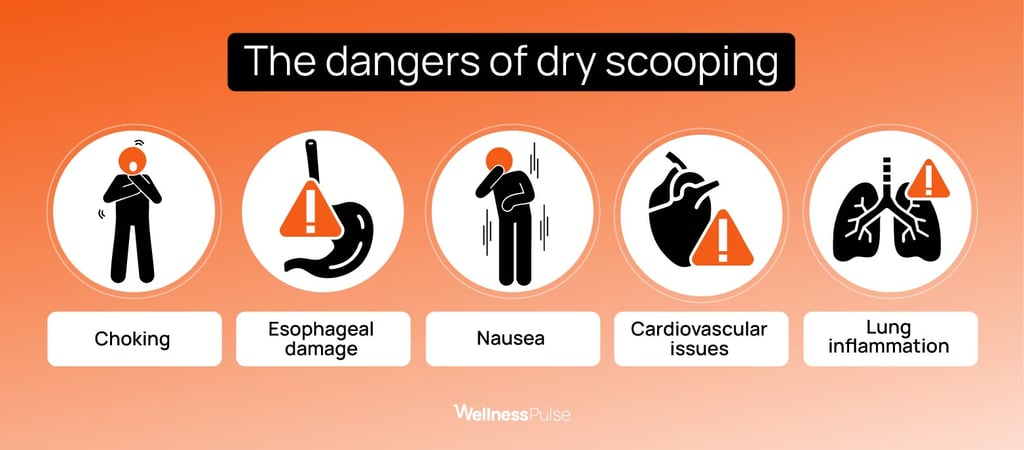
1. Choking
Supplements created to be mixed with water are a choking hazard when taken dry. First, dry powders can easily become airborne and enter your airways, where they may stick to your throat and airway wall, causing immediate breathing difficulties.
Next, saliva is almost never enough to dissolve the powder, resulting in a thick clump and a dry mouth and throat, making it difficult to swallow. The clump keeps absorbing moisture from your mouth and throat, which may result in smaller, harder clumps and create full or partial blockage when swallowed.
Lastly, a large volume of dry powder in the mouth is quite unnatural and may result in panic when the swallowing reflexes are overwhelmed, increasing the choking risk.
2. Esophageal damage
The Journal of General Internal Medicine released a case report where they described severe esophageal ulceration and abnormal esophageal thickening caused by dry scooping in a 22-year-old competitive weightlifter with no prior medical history.
The patient dry scooped 8 g of pre-workout 3–4 times a week for two weeks, before presenting to the hospital with four days of severe throat pain and difficulty swallowing. Doctors speculate that caffeine in the powder was the main culprit, but other ingredients like malic, citric, and tartaric acids could have caused chemical burns.
The patient recovered fully within four weeks of stopping all dry scooping and starting proton pump inhibitor therapy.
Although this is a case report of only one patient, it shows how detrimental even short-term dry scooping can be. Many may avoid contacting the doctor, which may result in long-term consequences.
3. Nausea
No studies directly examine dry scooping and nausea; however, several mechanisms make it common. Damage to the esophagus triggers nausea, as do high caffeine doses. The rapid absorption of caffeine in powder form can also cause nausea due to gastric irritation, anxiety, or stimulant-induced nausea.
Other ingredients in pre-workouts may also irritate the stomach and cause nausea. Dry scooping increases the risk as it may trigger a gag reflex, which can also result in nausea.
4. Cardiovascular issues
In severe cases, dry scooping may cause chest pain and even myocardial infarction. There is one case report where a 25-year-old otherwise healthy patient presented with a myocardial infarction. He has been consuming pre-workout supplements for eight months, around five times per week, according to manufacturer guidelines, but has started dry scooping for the past three days.
However, pre-workout supplements are associated with cardiovascular risks due to high caffeine content. A meta-analysis of 24 studies has found that mixed ingredient sport supplements tend to improve athletic performance and related metrics, but are also associated with heart palpitations, cardiac arrhythmia and ischemia, elevated heart rate, and other cardiovascular symptoms, usually due to high caffeine content.
However, the research is still inconclusive. You should consult your doctor before starting any supplements, especially one very high in caffeine. If you start having any heart palpitations, elevated heart rate, or chest pain, stop use and contact the doctor immediately.
5. Lung inflammation
Pre-workouts are usually fine powders that are easy to inhale accidentally. Inhaling foreign materials may cause lung infection — aspiration pneumonia. Inhaling pre-workout may also irritate the lungs, causing an inflammatory response.
However, there are currently no studies looking at dry scooping supplements and lung inflammation.
Using a supplement outside of manufacturer recommendations poses a serious health risk, and in the case of dry scooping, there are no benefits, nor is it enjoyable. Many creators say, "I used to do XYZ at the club, but now I dry scoop pre-workout at 6 a.m." Honestly, you shouldn’t. To keep things fun, experiment with pre-workout flavors if you really want to take them. For convenience's sake, you can opt for single-serving pre-workout shots, tablets, or even gummies.
How to properly take a pre-workout supplement
First, you do not need a fancy pre-workout supplement to get a good workout. Prioritize sleep, recovery, and nutrition, and have a cup of coffee before your workout if you want to. However, if you choose to take pre-workout supplements, you should always follow the guidelines provided on the packaging.
Most pre-workouts come as a powder that should be mixed with water.
- Add the recommended amount (usually a scoop or two) of powder into a shaker or a cup
- Add the recommended amount of water
- Shake and drink
If it sticks to the bottom of your cup, try adding a little bit of water before adding the powder. If you do not have a shaker, you can mix it with a spoon or a frother.
Also, prepackaged pre-workout shots are available, although they are more expensive per serving. Several companies have also released tablets and gummies if powders are too messy.
The crucial thing is not to exceed the recommended serving and keep an eye on the caffeine content. Some supplements have 100–150 mg of caffeine, which is similar to a cup of coffee, while others pack over 300 mg, almost reaching the daily recommended limit of 400 mg.
Bottom line
Dry scooping pre-workout is one of those ‘hardcore and cool’ trends, but in reality, it is dangerous to your health and offers no benefit. Sure, bringing a shaker and mixing it seems tedious and inconvenient, but maybe you should just plan better and bring a premixed drink to have on your way to the gym.
Also, there is no denying that hydration is crucial before and during your workout, so what is the point of dry scooping the powder and then drinking plain water to wash down the dusty taste and hydrate?
All in all, dry scooping pre-workout offers no benefits and should be avoided.
FAQ
Is dry scooping banned?
Dry scooping itself is not illegal, but many platforms have banned or restricted content related to it to limit its spread due to health concerns. Some gyms have also banned dry scooping on the premises as they do not want to be liable.
Are there any groups that should absolutely never try dry scooping?
Dry scooping is discouraged for everyone, but people with heart conditions, high blood pressure, or arrhythmias should never try dry scooping or pre-workouts in general due to cardiovascular risks. Also, people with swallowing disorders, esophageal problems, or respiratory conditions should avoid dry scooping due to choking risks. Pregnant or breastfeeding individuals and children under 18 should consult with a doctor or avoid pre-workouts due to their high caffeine content.
How long do dry scooping side effects last?
It depends on the severity of the side effects and how long you have been dry scooping. Generally, mild throat irritation may resolve in 24–48 hours, while severe esophageal damage needs medical treatment and may take 4–8 weeks. If aspiration pneumonia develops, you may require antibiotic treatment. Mild cardiovascular effects like elevated heart rate should clear in a couple of hours once the caffeine is metabolized. However, seek medical advice immediately if any side effects are persistent, severe, or concerning.
5 resources
- Journal of General Internal Medicine. Social media trends, dry scooping, and extensive esophageal ulcerations.
- SAGE Journals. Acute myocardial infarction following “dry scooping” of a pre-workout supplement in a healthy young man of African origin: a case report.
- Journal of Cardiovascular Development and Disease. Pre-workout supplements and their effects on cardiovascular health: an integrative review.
- StatPearls. Aspiration pneumonia.
- FDA. Spilling the beans: how much caffeine is too much?






Your email will not be published. All fields are required.