Around the 1960s, the world saw one of the first fitness wearables — a pedometer worn around the waist to count steps. Its primary goal was similar to that of modern wearables: to keep people active and healthy. Today’s devices are nothing like those humble step counters. Modern wearables measure a wide range of bodily signals and turn them into all sorts of scores, from simple heart rate and sleep metrics to VO₂max, calories burned, and more.
The recovery score is one of the most puzzling ones. Whether you’re using WHOOP, Oura, Garmin, or Fitbit, you’ll likely see some version of a recovery or readiness score. In this article, we’ll walk through what these scores are, what goes into them, where they can be helpful, and where not so much.
What is a recovery score
A recovery score, often also called a ‘readiness score,’ is an estimate of how well-rested and prepared your body is on a given day.
It’s calculated by combining several different wearable-derived metrics, most of which are collected overnight and in the days leading up to the score. Each major brand has its own version of a recovery score, and while they all differ, the general idea is the same: to provide a snapshot of where the body is and help guide training or everyday activity.
Recovery scores by device
WHOOP
WHOOP’s recovery score gives a daily percentage from 1% to 100%. The higher the score, the better the body is thought to be at adapting to various lifestyle stressors and prepared to perform. It has three color-coded zones:
- Green (67–99%) for high recovery
- Yellow (34–66%) for moderate recovery
- Red (1–33%) for low recovery
Oura
Oura gives a nightly personalized readiness score from 0 to 100. It reflects how ready you are to take on the challenges of the day, or whether it may be better to rest. Scores are grouped into three zones:
- Optimal (85–100)
- Good (70–84)
- Pay attention (below 70)
Garmin
Garmin has two related scores, both spanning from 0 to 100. Training readiness has five categories:
- Prime (95–100)
- High (75–94)
- Moderate (50–74)
- Low (25–49)
- Poor (1–24)
It is typically presented as a morning score meant to help plan workouts.
Body battery reflects overall energy levels throughout the day and changes in response to moment-to-moment strain and rest.
Fitbit
Fitbit daily readiness is also shown on a 0–100 scale. Scores of around 65 and above suggest good recovery and readiness for more intense exercise, while scores below 30 suggest fatigue and that the body really needs rest.
How is the recovery score calculated?
Each brand calculates its recovery score a bit differently, using its own algorithms and combination of measures, but some general principles overlap.
The physiological signals wearables rely on
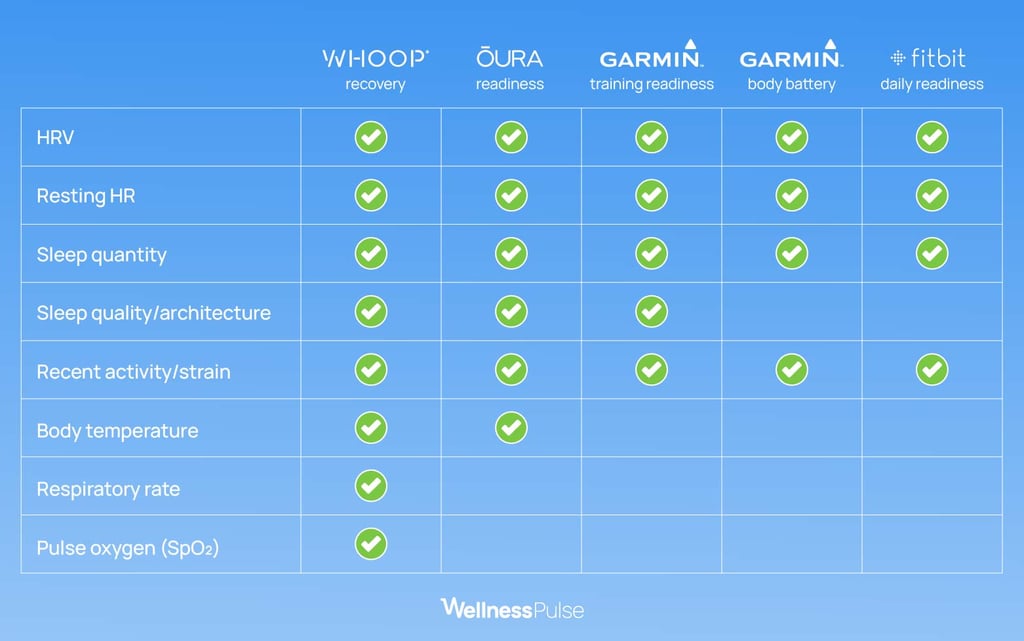
Although details vary, most recovery scores rely on the same set of core signals, with a few additional measures layered in. Heart rate variability (HRV) is often the biggest contributor, and other measures serve more as complementary inputs.
Heart rate variability
HRV typically carries the most weight in recovery scores, often even more than half of the score depends on it. It measures small variations in time between consecutive heartbeats and reflects how well the nervous system can adapt to different stressors.
When the body is well rested and under relatively low overall stress, these beat-to-beat intervals tend to vary more, and thus your wearable gives higher HRV values. Under strain, HRV usually decreases and often reflects the influence of poor sleep, illness, psychological stress, or heavy training.
Resting heart rate
Resting heart rate reflects baseline cardiovascular load and tends to change more slowly than HRV. It’s typically measured during periods of true rest, when there’s no physical or psychological strain, and for most adults falls roughly between 50 and 70 beats per minute.
A lower resting heart rate is generally associated with higher cardiovascular fitness. As people become more fit, they often notice their resting heart rate gradually decreasing over time. Conversely, values higher than one’s usual baseline can occur with accumulated fatigue, poor sleep, dehydration, illness, or ongoing stress.
It often reflects longer-term trends in recovery or strain rather than short-term, day-to-day fluctuations.
Sleep quantity and sleep quality
Sleep is when our bodies actually recover, so it shows up in nearly all recovery score calculations. Virtually all wearables use sleep duration, while only some also include sleep quality. How sleep quality is defined varies by brand — some look at how fragmented your sleep was, some focus on time spent in different sleep stages, and some derive a sleep score from a combination of several measures.
Recent activity or strain
Recovery is usually interpreted in relation to how much strain your body has been under recently. If you’ve trained harder than usual, moved more, or experienced higher overall strain, your body generally needs more time to recover.
Wearables estimate this in different ways. Most use a combination of heart rate responses, movement data, exercise duration, and stress metrics. Strain usually reflects not just what happened yesterday or last night, but how the recent load compares to what’s normal for your body.
Other measures
Beyond these four core signals, some wearables include additional measures such as skin temperature trends, respiratory rate, or blood oxygen saturation. For example, WHOOP includes one of the widest ranges of measures, while Fitbit’s approach is more minimalistic and focuses mainly on the four core signals.
Most wearables don’t rely solely on raw overnight values. Instead, scores are evaluated against your personal history and take into account both recent changes and longer-term trends.
One recovery score isn’t the same as another
If you wore two different wearables at the same time, you would probably notice that their recovery scores do not exactly match. They often fall within a similar range, but the numbers themselves are usually different.
This is not a flaw or an inaccuracy. It reflects an important point about recovery scores. They are not interchangeable. While most wearables aim to capture the same underlying concept and rely on overlapping signals, they each define and calculate recovery in their own way.
Each brand uses its own set of measures and its own method for combining them. Since most wearables place a lot of weight on HRV and many of the other inputs are similar, the scores often move in the same direction.
However, the combinations are not identical, and even shared measures like HRV or sleep can differ between devices because they are measured slightly differently. For example, Garmin typically calculates HRV as an average across the entire night, while WHOOP focuses more on HRV measured during specific sleep phases, such as slow-wave sleep.
With different methods and calculations, it is natural for recovery scores to differ.
Are recovery scores accurate?
That’s a harder question, and it depends on what we mean by accurate.
Accuracy is usually judged by comparing a measure to an agreed-upon gold standard. For recovery, no such standard exists. Individual inputs such as HRV or sleep duration can be evaluated against established reference methods, which gives us some sense of how accurately wearables capture the signals that go into their calculations.
As a whole, recovery scores are constructed metrics rather than direct physiological measures, and there is no single reference test against which they can be validated.
While companies generally share what goes into their recovery scores, they rarely disclose how those inputs are combined. Because the underlying algorithms are not public, these scores remain something of a black box and cannot be independently replicated or validated. Without knowing how much weight is given to each input, it’s difficult to interpret what a change in the score reflects.
In clinical and research settings, recovery is usually inferred indirectly, using proxies such as HRV, metabolic rate, next-day performance, or how recovered someone reports feeling. One way to evaluate wearable recovery scores is to see how well they line up with these measures.
The results so far are mixed. In one recent study of elite swimmers, WHOOP’s recovery score was not consistently associated with perceived recovery, stress, or resting metabolic rate, even though HRV measured by WHOOP was. Another study using Garmin devices in police officers similarly found no clear link between recovery scores and how recovered participants reported feeling.
A 2025 methodological review of wearable recovery and readiness scores pointed out another important issue — many of the inputs used in recovery scores are not independent. Poor sleep, for example, often lowers HRV. If both sleep and HRV are included separately, the same stressor may influence the score more than once, amplifying its effect. Again, without knowing how the algorithm handles this overlap, it’s difficult to assess the impact.
Overall, recovery scores may be informative, but they are not precise or medically validated measures of recovery. They summarize real physiological signals, but how those signals are combined, what the final number truly reflects, and whether that’s the best representation of recovery, remains unclear.
Why your recovery score can drop
Recovery scores are built from multiple inputs, so there are many possible reasons they can drop. Often, it’s not just a single factor but several overlapping ones. Common ones include:
- Poor (short or poor quality) or inconsistent sleep
- Intense training or overtraining
- Psychological stress
- Alcohol or late-night meals
- Illness or inflammation
- Travel, heat, or dehydration
If recovery scores stay consistently low and are accompanied by ongoing fatigue, elevated heart rate, shortness of breath, or other unusual symptoms, it’s worth considering a conversation with a healthcare professional.
Are recovery scores useful?
Recovery scores are most useful as a personal reference, where recovery is evaluated relative to your own norm. Everyone’s physiology differs, and these scores attempt to account for that.
For people who tend to overtrain or ignore early signs of fatigue, recovery scores can serve as a reminder to slow down. For others, they can be motivating — keeping the score higher can feel a bit like a game, and nudge people toward healthier habits.
Problems arise when these scores are treated as objective truths. Sometimes, how you feel doesn’t match what the wearable shows. Many people feel great on a ‘low recovery’ day or unexpectedly depleted on a ‘high recovery' one. Overreliance on the score can lead to pushing through fatigue or skipping workouts despite feeling capable.
Finally, fixating on numbers can also create anxiety, where maintaining a high score becomes a source of stress rather than guidance.
Using wearable data sanely
It’s important to remember that recovery scores are wellness tools designed by wearable companies, not objective or medical measures of recovery. They reflect how each device interprets a set of physiological signals, not a definitive answer about what your body can or cannot do.
Used thoughtfully, recovery scores can add useful context and occasionally give a helpful nudge toward healthier habits. At the same time, used blindly, they can distract from the body’s own signals. As in many areas of health, balance is key — perhaps a cliché for a reason.
It all really depends on the individual. Some people find wearables a helpful and motivating part of their fitness and lifestyle, while others find constant tracking stressful and prefer to rely on their own judgment. There’s no right or wrong approach here, only what works best for you.
FAQ
What’s a ‘good’ recovery score?
A ‘good’ recovery score depends on the wearable and how it defines recovery, but it’s usually considered optimal when it falls in the upper range (roughly above 75–85 out of 100). Usually, these scores are individualized and reflect your current state relative to your own baseline, not a universal standard.
How is a recovery score calculated?
Recovery scores aren’t direct measurements, but algorithm-derived estimates. Most rely on core physiological signals such as heart rate variability, resting heart rate, sleep duration, and recent strain or activity. Some brands include additional signals, and each wearable combines and weights these measures differently.
Why do scores differ between devices?
Each wearable has its own interpretation of what ‘recovery’ or ‘readiness’ means. Devices use different combinations of metrics, apply different weightings, and may even measure signals like HRV, resting heart rate, or sleep slightly differently. Because the inputs and calculations vary, the final scores can differ as well.
Are these scores accurate and reliable?
The underlying signals, such as heart rate and HRV, can be measured fairly accurately by modern wearables, though accuracy varies by device and metric. The recovery score itself, however, is an interpretation rather than a direct physiological measure. It’s most useful for tracking trends within yourself over time, rather than as a precise or absolute indicator.
Can stress lower recovery scores?
Yes. Psychological stress affects the body in ways similar to physical strain. It can lower HRV and raise resting heart rate, both of which are major inputs in recovery score calculations, and as a result, may dampen your recovery score.
Should I rest if my recovery score is low?
A low recovery score suggests that your body hasn’t fully recovered or is under an unusually high level of strain. This can be a useful signal to rest or opt for lighter activity. As always, it’s best used alongside how you actually feel, not completely instead of it.
Are wearable recovery scores medically accurate?
Recovery scores are not medical diagnostics. They’re wellness tools meant to support training and lifestyle decisions, not to diagnose health conditions. If low scores persist without a clear explanation, or are accompanied by unusual symptoms, it’s worth discussing them with a healthcare professional.
3 resources
- Translational Exercise Biomedicine. Readiness, recovery, and strain: an evaluation of composite health scores in consumer wearables
- International Journal of Sports Science & Coaching. Wearable technology metrics are associated with energy deficiency and psychological stress in elite swimmers.
- JMIR mHealth and uHealth. The effects of self-monitoring using a smartwatch and smartphone app on stress awareness, self-efficacy, and well-being–related outcomes in police officers: longitudinal mixed design study.





Your email will not be published. All fields are required.