Walk through any grocery store and you'll find products with "free from artificial preservatives,” “no colors added,” or “additive-free” labels. While these claims may suggest a healthier, more natural product, they may also be perceived by some people as part of marketing strategies aimed at growing consumer concerns.
With the rise of wellness trends and clean eating movements, food additives have become a source of confusion and controversy. Many people are wondering whether they are safe or necessary. As with most nutrition topics, the answer lies in the nuance.
In this article, I will guide you through an exploration of what food additives are, their purpose, current scientific knowledge, and how we can make balanced and informed decisions when selecting processed foods without falling into fear-driven thinking.
-
Additives are functional ingredients used to preserve freshness, improve texture, or enhance taste and appearance. They are not inherently ‘harmful’ or ‘healthy.’
-
The health impact of additives depends on the quantity consumed, overall diet quality, and individual sensitivity, not simply their presence in a product.
-
Additives are approved based on safety data, but staying informed, reading labels, and minimizing heavily processed food can help balance your intake.
What are food additives, and why are they used?
Food additives have been used for thousands of years. Ancient Egyptians used salt to preserve meat or saffron to color dishes. Today, food additives include over 2,500 substances added during food preparation, processing, or packaging to improve safety, stability, texture, or appearance.
It’s important to note that all new additives must be approved by regulatory bodies like the FDA in the U.S. or EFSA in the EU, based on toxicological and safety data.
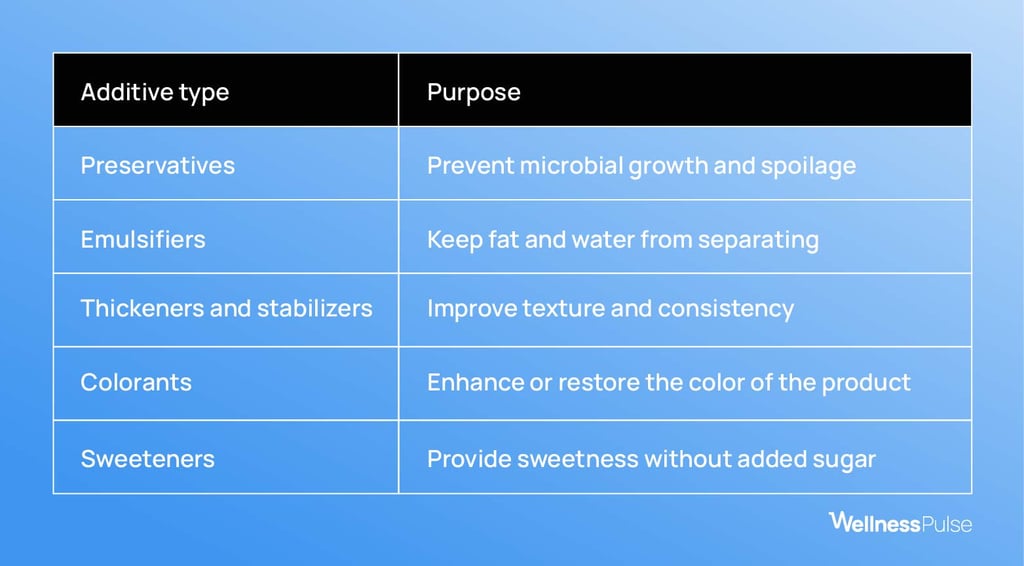
Food additives today are divided into some common types, including preservatives, emulsifiers, thickeners, stabilizers, colorants, and sweeteners. Let’s explore each category of additives more in-depth.
Preservatives
Preservatives are also known as antimicrobial substances, used to extend the shelf life of foods by protecting them against deterioration caused by microorganisms.
Some of the common preservatives include:
- Simple table salt (sodium chloride)
- Sorbates
- Benzoates
- Sulphites
- Nitrites or nitrates
- Acetates
- Propionates
They are commonly used in many food products and beverages, including fruit juices, wine, soft drinks, cider, pastries, cheese, pickled or candied fruits and vegetables, meat products, sauces, flavored dairy, or other prepped foods.
Preservatives on the labels may be written in two ways, either in full name, which is usually more common in the U.S., or marked with an E number in most European countries.
| Sorbates | Benzoates | Sulfites | Nitrites and nitrates | Acetates | Propionates |
| Sorbic acid (E200) | Benzoic acid (E210) | Sulphur dioxide (E220) | Potassium nitrites (E249) | Acetic acid (E260) | Propionic acid (E280) |
| Sodium sorbate (E201) | Sodium benzoate (E211) | Sodium sulfite (E221) | Sodium nitrites (E250) | Potassium acetate (E261) | Sodium propionate (E281) |
| Potassium sorbate (E202) | Potassium benzoate (E212) | Sodium hydrogen sulphites, sodium bisulphite (E222) | Sodium nitrates (E251) | Sodium acetates (E262) | Calcium propionates (E282) |
| Calcium sorbate (E203) | Calcium benzoate (E213) | Sodium metabisulphite (E223) | Potassium nitrates (E252) | Calcium acetate (E263) | Potassium propionate (E283) |
| Ethyl p-hydroxybenzoate (E214) Sodium salt of ethyl p-hydroxybenzoate (E215) | Potassium metabisulphite (E224) Calcium sulphite (E226) |
Emulsifiers, thickeners, and stabilizers
Emulsifiers, thickeners, and stabilisers help create a desirable texture and uniform appearance. They’re common in ice cream, plant milks, margarine, dressings, baked goods, and various sauces.
These may help maintain smoothness, prevent ingredient separation, or contribute to the improvement of shelf stability.
For example, without stabilizers, plant-based milk such as almond milk may separate into water and solids, losing its overall smooth and creamy texture. Meanwhile, emulsifiers help keep chocolate’s texture and consistency intact.
| Emulsifiers | Thickeners | Stabilizers |
| Lechitin (E322) | Guar gum (E412) | Carrageenan (E407) |
| Mono-diglycerides (E471) | Xanthan gum (E415) | Pectin (E440) |
| Acid esters (E472 a/b/c/e and E475) | Modified starches (E1400–E1450) | Alginate (E400–E405) |
| Sorbitan monostearate (E491) | Locust bean gum (E410) | Cellulose gum (E466) |
| Sorbitan tristearate (E492) Polysorbate 60 (E435) Polysorbate 65 (E436) Polysorbate 80 (E433) |
Colorants
The color of food is one of the primary determinants of food choices. However, since natural food colouring pigments are generally unstable during processing, in order to maintain and restore product color uniformity, colorants are added to different processed foods.
You are most likely to find food colors in candies, sodas, yogurts, cereals, flavored chips, sauces, and sometimes even products such as pickles. Colors are often also used in various highly processed snacks.
Natural colors are obtained from nature, usually from various plants. Natural colors have some issues with instability in water, when exposed to light or heat, or different ingredients within the product, thus, food producers may include synthetic colors more often as well.
Synthetic or artificial colors do not occur in nature due to their chemical structure. While these artificial colors may have advantages in food production, some of the colors are associated with certain health issues. As such, some colors are already banned or must have warning labels on foods.
| Natural colors or colors synthesized equally to the natural | Synthetic food colors |
| Curcumin (E100) | Tartrazine (E102) |
| Riboflavin and riboflavin-5’-phosphate (E101i and E101ii) | Quinoline yellow (E104) |
| Carmines (E120) | Sunset yellow (E110) |
| Chlorophylls (E140i or E140ii) | Azorubine (E122) |
| Caramels (E150) | Amaranth (E123) |
| Vegetable carbon (E153) | Ponceau 4R (E124) |
| Carotenes (E160a) | Erythrosine (E127) |
| Annatto (E160i) | Allura red AC (E129) |
| Paprika extract (E160c) | Patent blue V (E131) |
| Lycopene (E160d) | Indigotine (E132) |
| Lutein (E161b) | Brilliant blue FCF (E133) |
| Canthaxanthin (E161g) | Green S (E142) |
| Beetroot-red (E162) | Brilliant black PN (E151) |
| Anthocyanins (E163) | Brown HT (E155) |
Sweeteners
Similarly to colors, sweeteners can also be naturally derived or synthetic. Sweeteners may improve perceived taste and increase the pleasure of eating, thus, sweeteners are usually found in many carbonated beverages, baked goods, candies, and confectionery.
Most sweeteners are considered generally safe at approved levels. However, some animal research and scientific reviews suggest that certain sweeteners, both natural and synthetic, may negatively impact health when consumed in excess, especially in terms of gut microbiota.
| Naturally derived sweeteners | Synthetic sweeteners |
| Stevia | Aspartame |
| Polyols or sugar alcohols (erythritol, mannitol, xylitol) | Neotame |
| Monk fruit extract | Saccharin |
| Acesulfame-k Sucralose Advantame |
Should we fear all food additives?
The short answer is no. However, from a nutritionist’s perspective, the more responsible one for me is — it depends. Fear, as an emotion, tends to oversimplify what is in fact a highly nuanced and layered topic.
Social media often hyperbolizes certain case studies about additives this way, encouraging fear of all food additives or simply chemically sounding names on the ingredients label.
However, food additives encompass a vast range of substances, as we explored at the beginning of this article. They have very different functions, sources, safety profiles, and regulatory histories.
However, shedding a negative, suspicious light on all additives can lead to misunderstanding and sometimes even poor dietary choices.
Food additives are not inherently ‘dangerous’ as they are tools used to preserve foods, enhance texture, ensure the safety of the food we consume, and maintain freshness in some cases.
Distinguishing between additives and health concerns
Dr. Angelika Tritscher, Coordinator in Risk Assessment and Management Department of Food Safety and Zoonoses World Health Organizations, says in a YouTube video: “Only those food additives that have undergone a JEFCA (International Scientific Expert Committee Administered Jointly by the FAO and WHO) safety assessment and found not to present a health risk can then be used for their intended purpose.”
Whether additives pose any meaningful risk depends on how they are used, in what quantities, by whom, and in what context.
For example, preservatives like sorbic acid or sodium benzoate are used to prevent microbial growth and spoilage in packaged and processed foods, directly reducing the risk of foodborne illness, which, in fact, plays a crucial role in maintaining health. These substances are tightly regulated by authorities like the WHO, which sets acceptable daily intakes.
Meanwhile, nitrites and nitrates, usually found in processed meats, for instance, are effective at preventing the growth of Clostridium botulinum, ‘harmful’ bacteria. They’re also associated with a potential risk increase in colorectal cancer when consumed in large quantities, frequently, and only under certain conditions, like low vitamin C intake. This does not mean that such substances will be banned altogether, but it does suggest a need for balanced intake and further research, as the scientific consensus is not yet reached.
Artificial colors have also drawn scrutiny for possible links to hyperactivity in children. However, again, this may highly depend on the dose, environmental, genetic, and other dietary factors of each individual child. The FDA has conducted and published a comprehensive exposure assessment, suggesting that we still lack rigorous scientific research to understand the actual impact of food dyes and hyperactivity.
These are just a few examples. However, translating these potential findings to real-world human diets is complex and requires more high-quality clinical evidence.
While I do not try to impose that additives are beneficial to us in any kind of way, looking from another perspective, food without preservatives that spoils quickly may actually be riskier from a microbiological standpoint than one with a small amount of additives.
Moreover, natural alternatives to these additives may still pose allergy risks or interact with other ingredients in unforeseen ways.
Additives in a broader nutrition context
The most important aspect in terms of additives is actually the overall dietary pattern, frequency of use of processed foods, and your individual health status.
Long-term, meaningful health outcomes may rarely be driven by a single or a few additives in isolation. However, while a diet high in ultra-processed foods may contain dozens of additives, its health risks more often stem from excess sugar, salt, refined carbohydrates, and low fiber content or a synergy of these less desirable nutrients and additional additives, not necessarily from the additives alone.
So, when reading the ingredient labels, it's important to assess aspects of the overall nutritional properties of the food, how often you may be consuming highly processed foods, and your personal dietary needs due to certain sensitivities or health conditions.
Following dietary guidelines and including more whole foods like grains, legumes, vegetables, fruits, dairy products, plant-based foods, lean meats, fish, and seafood will ensure that you support your overall health despite an occasional inclusion of highly processed foods and certain additives for that matter.
When to avoid certain additives
While balance is key and you should prioritize whole foods, some groups of people should read ingredient labels with a bit more caution. Those people include:
- People with asthma or sulfite sensitivity. Sulfites may potentially trigger some respiratory reactions in more sensitive individuals, thus, regulatory authorities require labeling for sulfates if present at >10 ppm due to the potential risk increase.
- Children with certain sensitivities and pregnant individuals. Certain preservatives, such as benzoates, artificial food colors, and nitrates, while still under research, are commonly recommended to be minimized for these sensitive groups due to potential associations with hypersensitivity reactions.
- People with gastrointestinal disorders. Some additives are associated with mild gastrointestinal side effects, especially when used in large amounts. While generally additives may not have any impact, if the diet is heavily based on highly processed foods, it may contribute to the risk of excessive bloating, excessive gas, or diarrhea.
Reading labels without losing your mind
The key to navigating any nutritional information is assessing and analyzing nutrition labels, which provide more information about the food you want to consume to make informed decisions.
These key strategies include:
- Read the ingredients list carefully. The ingredients list is usually written in descending order by weight. If the first few ingredients are additives like colors or sweeteners, the product may be highly processed.
- Understand additive types and their functions. Knowing the purpose of additives can help you determine whether they are essential for the product's safety or merely for aesthetics — and what matters more to you personally. Preservatives, emulsifiers, and stabilizers usually provide textural properties, safety, and stability of the product; colorants, flavor enhancers, and sweeteners focus on taste and visual appeal.
- Look for mandatory warning statements on the food label. Some additives require special labeling, for example, some artificial colors, polyols, or aspartame may be labeled with disclaimers that may help you navigate whether the food is suitable for you personally.
- Be aware of code words and catch all terms used. For example, some labels may write ‘color added,’ which doesn’t specify if the source is synthetic or natural. When in doubt — look for alternatives that have very clear ingredient lists, especially if you have certain sensitivities.
Bottom line
Not all food additives are inherently harmful — many may serve important roles in food safety, stability, and quality. While certain groups may need to be more cautious, especially if consumed frequently, most additives are safe when used within regulated limits.
Instead of fearing all additives, aim to understand their purpose and prioritize a balanced, whole-food-based diet. Remember, a critical, science-informed approach means neither blindly trusting nor reflexively fearing food additives, but making informed decisions based on your personalised health goals.
FAQ
Are there any food additives linked to gut microbiome changes?
Some studies suggest that certain emulsifiers may contribute to the gut microbiota changes and the mucosal barrier in animal studies. However, human data is still not conclusive, so we do lack information about how it may impact our gut health. In any case, frequent and large consumption of ultra-processed foods may contribute to dysbiosis indirectly due to low fiber and high sugar content, more so than the additive alone.
Do food additives disrupt hormones or act as endocrine disruptors?
Some additives, like certain preservatives, have been studied for potential endocrine-disrupting effects. However, most food additives currently allowed in foods are not classified as endocrine disruptors. The risk, if any, generally may arise from cumulative exposure across multiple sources, not from food alone. The EFSA and FDA regularly reassess such risks as more data emerges.
Are ‘natural’ food additives always safer than synthetic ones?
Not necessarily. ‘Natural’ does not automatically mean ‘safer’ or ‘healthier.’ For example, carmine (a natural red dye from insects) may trigger allergic reactions in some individuals, while some synthetic additives have been rigorously tested and deemed safe at approved levels. Safety depends on the specific compound, dose, and individual sensitivity — not its origin.
26 resources
- Food Additives and Human Health. Historical background of food additives, their advantages and drawbacks.
- Diet, Nutrition, and Cancer: Directions for Research. Food additives, contaminants, carcinogens, and mutagens.
- FDA. Understanding how the FDA regulates food additives and GRAS ingredients.
- EFSA. Food additives.
- Food Science & Nutrition Research. Food additives: overview of related safety concerns.
- Journal of Food and Agriculture. Food preservatives - an overview on application and side effects.
- European Commission. Food and feed information portal database.
- Food Emulsions Fourth Edition. Food emulsifiers: their chemical and physical properties.
- Foods. Food colour additives: a synoptical overview on their chemical properties, applications in food products, and health side effects.
- Annual Revision of Food Science Technology. Natural colorants: food colorants from natural sources.
- Nutrition. Non-nutritive sweeteners: review and update.
- FDA. Aspartame and other sweeteners in food.
- Advances in Nutrition. Effects of sweeteners on the gut microbiota: a review of experimental studies and clinical trials.
- European Commission. Food safety and additives.
- Introduction to the Chemistry of Food. Food additives.
- International Journal of Food Science. Effects of acidification and preservatives on microbial growth during storage of orange fleshed sweet potato puree.
- WHO. Sodium benzoate.
- Antioxidants. Nitrates/nitrites in food - risk for nitrosative stress and benefits.
- International Journal of Cancer. Dietary nitrate and nitrite intake and risk of colorectal cancer in the Shanghai women’s health study.
- Environmental Health. Potential impacts of synthetic food dyes on activity and attention in children: a review of the human and animal evidence.
- Science Board to the FDA. Color additives and behavioral effects in children.
- USDA. Dietary guidelines for Americans.
- FDA. FDA alerts health care professionals, compounders and patients of potential safety risks associated with sulfite-containing compounded drugs.
- Reviews of Environmental Health. Association between food additives and prevalence of allergic reactions in children: a systematic review.
- Archives of Medical Science. The impact of selected food additives on the gastrointestinal tract in the example of nonspecific inflammatory bowel diseases.
- NHS. Food labels.




Your email will not be published. All fields are required.