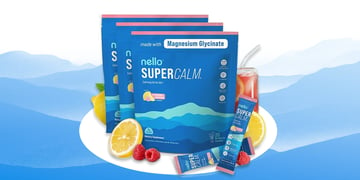
Nello Supercalm, a powdered drink for stress reduction, is now available at Target. But are dietary supplements enough to make us feel calmer in a world full of stressors?
Mounting bills, an unstable job market, and global conflicts can easily make us worried. So it should come as no surprise that nearly half of Americans report being frequently stressed, while 57% don't get sufficient sleep, which can further increase their stress levels.
When we feel stressed, the adrenal glands, tiny organs located on the kidneys, release the hormone cortisol, which suppresses multiple body systems.
When stress is prolonged, so is cortisol release. As a result, multiple body processes can be disrupted, putting individuals at a higher risk of mental health and digestive problems, headaches, and pain, among other health issues.
Google searches for cortisol reducing supplements have risen nearly fivefold since May 2022, reflecting the increasing interest in managing the so-called stress hormone.
Nello Supercalm supplements that are marketed to help reduce cortisol levels and stress have been widely advertised on social media and are now available at Target, its first brick-and-mortar location. But is this powder as good as influencers say? Let's look at the science behind it.
-
Nello Supercalm supplements, now available at Target, promise to keep cortisol levels in check and support mood and sleep.
-
Some ingredients, like ashwagandha, have been shown to have a positive effect on stress, while others lack strong evidence for their effectiveness.
-
Nello Supercalm may interact with medications for high blood pressure and seizures, among others, and shouldn't be used during pregnancy or breastfeeding.
-
Supplements for stress reduction should always be combined with a balanced diet and lifestyle choices like exercise and relaxation practices.
What can Nello Supercalm do?
The Nello Supercalm supplement claims to support healthy cortisol levels, improve mood and focus, promote sleep quality, and manage occasional stress and anxiety.
According to the manufacturer, it contains clinically studied ingredients and is third-party tested. Moreover, it has a certificate of Good Manufacturing Practice, verifying that a company adheres to quality standards and ensures the safety and quality of products.
The powdered drink mix comes in eight flavors and costs about $40 for a 20-pack bag.
These are the ingredients in the Nello Supercalm supplement and their purported benefits:
- For better mood: vitamin D3, the amount equal to 130% of the recommended daily value
- For better sleep: magnesium glycinate, the amount equal to 25% of the recommended daily value
- For calm: 400 mg of l-theanine
- For stress relief: 300 mg of ashwagandha root extract
What are the Nello Supercalm benefits?
There are no studies evaluating the effectiveness of the Nello Supercalm powdered drink specifically, while high-quality clinical trials are only available for individual ingredients.
Vitamin D (cholecalciferol)
Evidence of vitamin D supplementation benefits on mood in healthy people is mixed, as most studies didn't show sufficient increases in vitamin D levels in the body to improve mood and sleep.
A 2024 meta-analysis of randomized clinical trials found that supplementation with 1000 IU of vitamin D3 a day slightly reduced depressive symptoms in individuals with and without depression, with more pronounced effects in individuals with depression.
However, the observed benefits were short-term, and vitamin D3 supplementation had no significant impact on anxiety symptoms.
It's noteworthy that nearly 42% of Americans are estimated to have vitamin D deficiency, which may lead to bone disorders and impact the immune system. Therefore, individuals with a medically confirmed deficiency may benefit from vitamin D supplementation.
Magnesium glycinate
Magnesium glycinate is a form of magnesium that is chelated with an amino acid called glycinate. The body needs the mineral to support muscle and nerve function, control blood glucose, and regulate blood pressure, among other functions.
But can magnesium make us sleep better? A 2024 review of randomized clinical trials involving 151 older adults didn't find strong evidence that magnesium significantly improved total sleep, the amount a person is actually sleeping.
However, magnesium supplements may also have other benefits for sleep, as discovered in a 2012 trial. The study included 46 older individuals who were randomized to take 500 mg of magnesium or placebo daily for eight weeks.
Individuals who took magnesium saw improvements in subjective measures of insomnia, such as increased sleep efficiency and reduced time to fall asleep, as well as early morning awakening. However, there were no significant differences between groups in total sleep time.
L-theanine
L-theanine is a non-protein amino acid commonly found in green tea (Camellia sinensis) and has been used for centuries for its proposed calming effects.
Studies suggest that supplementation with 50-250 mg of l-theanine daily may promote the state of psychophysical relaxation because it increases alpha brainwaves in healthy people. These waves occur when people are awake, relaxed, and unfocused.
However, the relaxing effect of l-theanine was observed only in people with slightly higher than average anxiety or during periods of stress. Moreover, the findings are inconsistent, as studies report l-theanine's both positive and negative impacts on relaxation.
A 2007 study testing l-theanine's anti-stress properties found that compared to placebo, its intake reduced heart rate and salivary immunoglobulin A responses to acute stress. A type of antibody found in saliva, salivary immunoglobulin A, usually increases in response to acute stress.
The changes observed in the study were attributed to calming down the sympathetic nervous system, which is activated by stress.
Ashwagandha
Also known as Withania somnifera, the evergreen shrub is an increasingly popular supplement, with the global market size for its extract projected to reach $815.7 million this year.
According to a 2022 systematic review, ashwagandha supplementation was shown to significantly reduce anxiety and stress levels compared to the placebo.

Clinical guidelines from the World Federation of Societies of Biological Psychiatry and the Canadian Network for Mood and Anxiety Treatments provisionally recommend ashwagandha for the treatment of generalized anxiety disorder.
For ashwagandha root extract, the common doses used by different brands are between 300 to 600 mg.
What are the risks of Nello Supercalm?
Ingredients in the Supercalm supplement are generally safe and well tolerated, but it is crucial to know their potential interactions with other medications.
For example, taking Vitamin D with hydrochlorothiazide, a drug to lower blood pressure, may cause blood calcium levels to become too high. It also shouldn't be used with calcitriol, a synthetic form of vitamin D, as the combination may lead to excessive intake of the vitamin.
Two Nello Supercalm ingredients, magnesium glycinate and vitamin D in the form of cholacalciferol, may result in too high magnesium levels when taken together, especially in individuals with reduced kidney function.
According to the National Institutes of Health, ashwagandha appears to be well tolerated for up to about three months of use, but its long-term safety is unknown. However, common ashwagandha side effects, like loose stools, nausea, and drowsiness, are usually mild.
Ashwagandha may interact with some medications, including those for diabetes and high blood pressure, immunosuppressants, sedatives, anti-seizure medications, and thyroid hormone medications. The herb shouldn't be used during pregnancy and while breastfeeding.
These are just a few of the potential drug interactions and side effects. Discuss the use of any supplements with your healthcare provider, especially if you have chronic conditions and are on medications.
Do supplements for stress reduction work?
Theresa Larkin, an associate professor at the University of Wollongong, says some dietary supplements, such as vitamin D, vitamin B, and omega 3 fatty acids, can help moderate mental health and thus stress, but only in cases of deficiency. Other supplements that help with sleep can also contribute to stress reduction.
However, dietary supplements will only have short-term effects, Larkin says, so it is important to combine them with other changes to help reduce perceptions of stress in the long term.
When a dietary supplement is a tea or hot drink and the person sits and drinks it slowly, this in itself can be a de-stress because it is relaxing and down time.
Theresa Larkin, PhD
What else can I do to reduce stress?
Anti-stress supplements should be combined with dietary and lifestyle changes, according to Maria Andonopoulos, an accredited practicing dietician, nutritionist, and food scientist. She recommends focusing on whole, unprocessed foods like fruits, vegetables, lean proteins, and whole grains.
For example, fatty fish like salmon and tuna are rich in omega-3 fatty acids, which have been linked to lower stress and anxiety levels.
According to Andonopoulos, adopting these habits may also help to keep stress at bay:
- Eat regular meals and snacks
- Stay hydrated
- Limit processed foods, added sugars, and caffeine
- Limit alcohol
- Consider a Mediterranean diet
- Incorporate exercise, mindfulness, and relaxation practices
- Get sufficient sleep
Larkin says it is important to live close to the natural day-night rhythm. This includes sleeping when it’s dark, getting some morning sun, and being active and exercising during the daylight hours. Not over-eating at night can also contribute to having a healthy cortisol pattern.
Limiting screen time and increasing time spent with loved ones and people that energize are as well important for stress reduction, according to Andonopoulos.
A key strategy which I advocate for is creating healthy boundaries – saying no to people and commitments to not overload yourself and deplete your energy and increase stress.
Maria Andonopoulos, RD
The verdict
Some Nello Supercalm ingredients like ashwagandha and vitamin D have been shown to have positive impacts on mood and stress levels. However, the supplements may interact with medications, including those for blood pressure and thyroid hormones, and are not suitable during pregnancy and breastfeeding.
15 resources
- Sleep Medicine Reviews. Effects of vitamin D on mood and sleep in the healthy population: Interpretations from the serotonergic pathway.
- Psychological Medicine. The effect of vitamin D supplementation on depression: a systematic review and dose-response meta-analysis of randomized controlled trials.
- Cureus. Prevalence of Vitamin D deficiency and associated risk factors in the US Population (2011-2012).
- Nutrients. Vitamin D’s effect on immune function.
- Office of Dietary Supplements. Magnesium.
- BMC Complementary Medicine and Therapies. Oral magnesium supplementation for insomnia in older adults: a systematic review & meta-analysis.
- Journal of Research in Medical Sciences. The effect of magnesium supplementation on primary insomnia in elderly: A double-blind placebo-controlled clinical trial.
- Nutrition Research. L-theanine: From tea leaf to trending supplement – does the science match the hype for brain health and relaxation?
- Biological Psychology. L-theanine reduces psychological and physiological stress responses.
- Phytotherapy Research Does Ashwagandha supplementation have a beneficial effect on the management of anxiety and stress? A systematic review and meta-analysis of randomized controlled trials.
- Office of Dietary Supplements. Ashwagandha: Is it helpful for stress, anxiety, or sleep?
- Drugs.com. Drug interactions between hydrochlorothiazide and Vitamin D3.
- Drugs.com. Drug Interactions between calcitriol and Vitamin D3.
- Drugs.com. Drug interactions between magnesium glycinate and Vitamin D3.
- National Center for Complementary and Integrative Health. Ashwagandha.





Your email will not be published. All fields are required.