Red light therapy masks have become increasingly popular, and for good reason: research continues to support the potential benefits of red and near-infrared light for skin health.
But with more options hitting the market, choosing the right one can be overwhelming. Bon Charge and Omnilux are some of the popular options, but at first glance, they seem so similar. Both use red and near-infrared wavelengths, both are designed for at-home use, and both are similarly priced. So, which one would be a better choice?
After evaluating both of these masks, I sat down to help you make up your mind.
Quick overview
Here’s how Bon Charge and Omnilux compare at a glance:
| Bon Charge | Omnilux | |
| Wavelengths | 630 nm (red) and 850 nm (near-infrared) | 633 nm (red) and 830 nm (near-infrared) |
| Number of LEDs | 240 | 132 |
| Material | Silicone | Silicone |
| Certifications | CE | FDA-cleared, CE, TGA |
| Warranty | 1 years | 2 years |
| Price | $296.65 | $345.00 |
| Money-back guarantee | 30 days | 30 days |
About Bon Charge
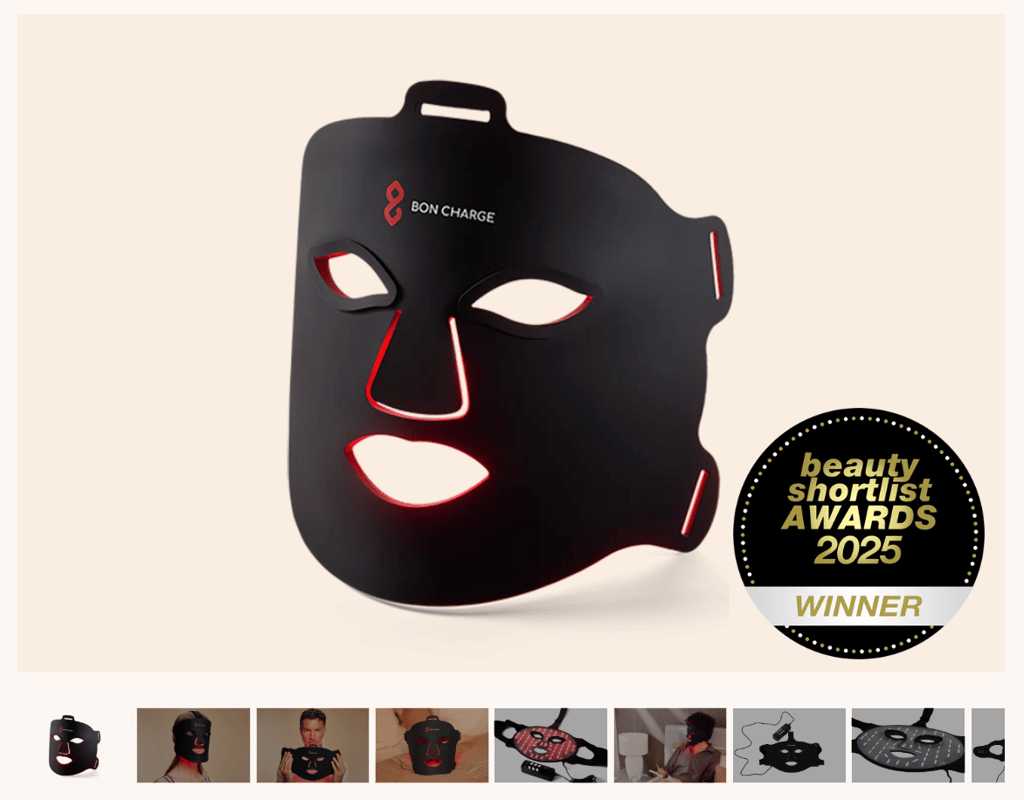
Bon Charge Red Light Face Mask is a wearable LED device designed for at-home usage. It uses red (630 nm) and near-infrared (850 nm) light to potentially target skin at a cellular level, aiming to support skin elasticity, soften the appearance of fine lines, and restore radiance.
Bon Charge is lightweight, uses a flexible silicone design, is hands-free, and contours to the face. Compared to Omnilux, it contains more LEDs, 240 LEDs versus 132 found in Omnilux.
At $$296.65, it is the more affordable option of the two, although the difference is small. However, this mask is covered by only 1 year of warranty, compared to Omnilux’s 2-year coverage.
About Omnilux
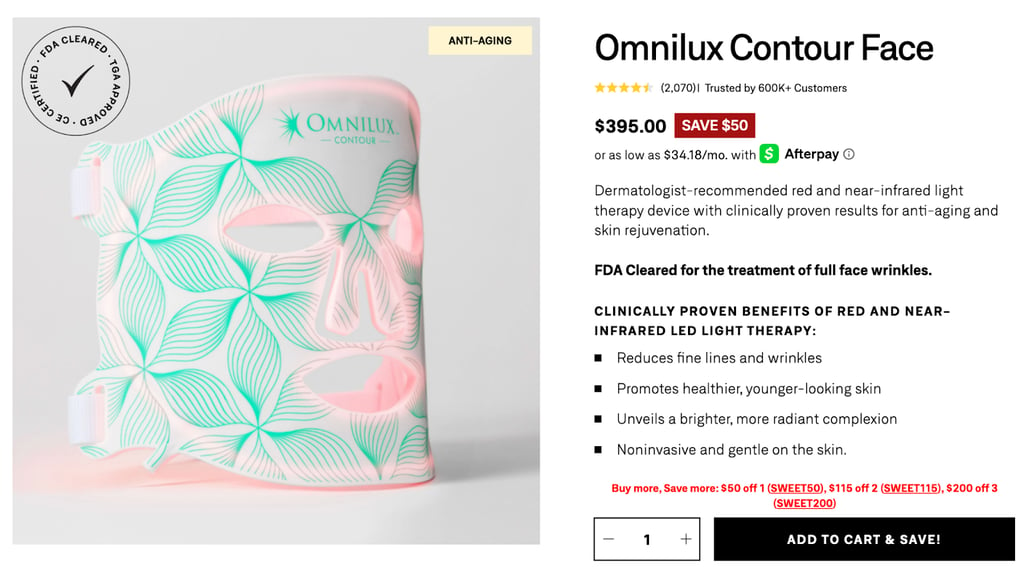
Omnilux Contour Face is also a wearable LED device for at-home usage. The mask emits red (633 nm) and near-infrared (830 nm) light for proposed skin health benefits, such as fine line and wrinkle support and promoting brighter, more glowing skin.
What stands out most about Omnilux is its certifications. It holds TGA and CE certifications, indicating that the device meets established safety and quality standards in regulated markets. Omnilux’s mask is also FDA-cleared, which can not be said about Bon Charge.
Bon Charge vs. Omnilux: wavelengths
Both masks emit a combination of red and near-infrared light, which are used in red light therapy research. However, the specific wavelengths differ slightly. Would that make any impact?
Most likely, no. Bon Charge uses 630 nm (red) and 850 nm (near-infrared), while Omnilux uses 633 nm (red) and 830 nm (near-infrared). In practice, these differences are minimal, and both fall within the ranges studied for skin rejuvenation.
For instance, one study gives the range of 630–680 nm for the red light and 800–830 nm for near-infrared as the most widely studied wavelengths, although up to 850 nm is also widely used in research.
In short, neither has a clear advantage in this category.
Bon Charge vs. Omnilux: certifications
This is perhaps the biggest difference between the two devices, and one I can't overlook.
Omnilux Contour Face is FDA-cleared, CE-marked, and TGA-certified. These certifications indicate that the device has undergone regulatory review and meets the requirements.
Bon Charge Red Light Face Mask, on the other hand, is not FDA-cleared. This does not make the product unsafe, but it does mean that the device has not been independently evaluated to the same regulatory standard as Omnilux. However, Bon Charge does have the CE certification according to the official manual.
Bon Charge vs. Omnilux: pricing
Bon Charge comes in at $296.65, making it slightly cheaper than Omnilux at $345.00. Both have the same 30-day money-back window.
Omnilux offers a 2-year warranty, while Bon Charge provides a 1-year warranty. Both brands cover defects in materials or workmanship, as well as malfunctions that occur under normal usage conditions.
Bon Charge vs. Omnilux: customer reviews
On Trustpilot, Bon Charge has a significantly better rating, 4.5 out of 5, whilst Omnilux is currently rated at 2.3. However, Bon Charge has more than 1,000 reviews, and Omnilux has only 212.
For Bon Charge, the main positives mentioned by customers relate to the products themselves, including their high quality, well-thought-out designs and overall effectiveness. Negative reviews are mostly about slow shipping and issues with customer service.
For Omnilux, Trustpilot reviews are mostly negative, with reviewers frequently complaining about faulty devices that stopped working shortly after the purchase. Unsatisfactory customer service is also often mentioned — long reply times are common.
On the official website, Bon Charge has only a few reviews for this mask, but the overall rating is high at 4.9 out of 5 stars. Users praise the mask for being easy to use, delivering skin improvements (firmer, glowing, more youthful), offering excellent customer service, and being comfortable and portable. On the other hand, for some users, the mask is too small as it doesn’t cover their entire face. Another drawback is short battery life.
Omnilux Contour Face has over 2,000 reviews on its official website, most of them positive, averaging 4.6 out of 5 stars. Many report visible improvements in their skin, including reduced fine lines and a brighter, smoother complexion. Negative reviews include complaints about product malfunctions, such as LEDs failing and batteries dying. Some also describe the light as too harsh on their eyes.
Bottom line
After comparing these two masks, I believe the best choice depends on what matters most to you.
Choose Omnilux if certifications are your priority. Its FDA clearance, CE marking, and TGA certification indicate that the device has undergone several regulatory reviews. The slightly higher price and fewer LEDs are offset by the longer 2-year warranty, although customer reviews indicate potential device malfunctions.
Choose Bon Charge if higher LED coverage and brand reputation matter most. With 240 LEDs, a slightly lower price, and consistently high user ratings, it stands as a solid choice in the red light therapy market.
If you are unsure if red light therapy is the right choice for you in general, it is best to consult your dermatologist for more personalized advice.
2 resources
- Photodermatology, Photoimmunology & Photomedicine. Noninvasive red and near-infrared wavelength-induced photobiomodulation: promoting impaired cutaneous wound healing.
- Photomedicine and Laser Surgery. A controlled trial to determine the efficacy of red and near-infrared light treatment in patient satisfaction, reduction of fine lines, wrinkles, skin roughness, and intradermal collagen density increase.


Your email will not be published. All fields are required.