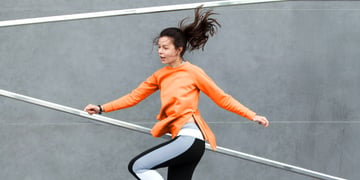
I am constantly amazed whenever I watch basketball or gymnastics. Seeing them jump around without breaking a sweat always leaves me wondering how they do it. The secret often lies in what’s known as jump training — a workout method that builds strength and athletic prowess. But is it only for professionals?
In this article, I discuss how incorporating jump training into your fitness plan can have you looking and feeling more energized.
-
Jump training develops strength through dynamic, rapid movements that challenge your muscles differently from traditional exercise.
-
Anyone can benefit from modified jump training, from elite athletes to beginners seeking better bone health and coordination.
-
Starting slowly with proper form prevents injury and builds the foundation for more advanced jumping movements over time.
What is jump training?
Jump training, also called plyometric training, involves exercises where your muscles are pushed to exert maximum force in very short bursts. You could think of it as training your body to be like a coiled spring, compressing yourself down and then exploding upward with power and speed.
The key to jump training is the stretch-shortening cycle that your muscles go through. When you land from a jump, your muscles stretch and then immediately contract, releasing stored energy ready to propel you upward again, a bit like when you ping an elastic band.
Unlike regular cardio or strength training, jump training is about building speed and explosive power in your body. I use cardio to increase my endurance, weights to sculpt and strengthen my body, and jump training to fill the gap. It converts the strength I’ve built into quick and powerful movements that make me feel agile and nimble.
Types of jump training
Jump training tends to fall into the two main categories mentioned below. However, personal trainers and gym classes often have their own creative takes to make these more interesting.
1. Plyometrics

Plyometrics is a classic type of jump exercise that involves quick transitions between landing and jumping.
Take box jumps, for example. You jump onto a raised platform, step down, and do it all over again. Squat jumping and tuck jumps also fall into this category, with the goal being maximum effort from the body in the shortest amount of time.
From my experience, this exercise is far more demanding than it looks. When I first started doing it, despite being a gym rat, I was absolutely exhausted.
2. Bounding and hopping

When thinking of bounding, I find it helpful to imagine a long jumper's approach to the landing pit. They are definitely running, but they kind of move from side to side. This is bounding, with more of an emphasis on horizontal movement rather than vertical leaping.
Hopping is exactly how it sounds and includes exercises like single-leg hops and lateral hops. These kinds of movements are designed to improve coordination, balance, and the ability to absorb and redirect force quickly and efficiently. I find them particularly useful for improving stability and speed when changing direction.
Benefits of jump training
Here are some possible benefits you may receive by adding jump training to your exercise routine.
Physical benefits
Jump training develops our fast-twitch muscle fibers, responsible for the quick movements you see when a volleyball player makes an epic jump or a goalie leaps for a legendary save. When we jump train, our legs and core get stronger, and the whole body learns to move more effectively as a coordinated unit.
The agility benefits are my personal favorite, especially reaction time. I’ve often used quick turns and jumps to save a glass or recover from a stumble — practical skills in action
Mental benefits
I think the mental benefits are more subtle, but for me, there’s definitely a sense of athletic confidence. Jump training also demands a pretty hefty amount of concentration, too. You've got to think about proper form, jump timing, and the mechanics of landing all at the same time, which might help improve focus and mental agility as well.
Who should consider jump training?
I personally believe that everyone may benefit from jump training, as long as it’s taught and executed safely, and in line with your current fitness levels.
Athletes
Research suggests that basketball and volleyball players benefit enormously from both plyometrics and combined jump and strength training methods. In those particular sports, higher jumps generally mean better personal and team performance overall.
There’s also some interesting research showing how plyometric jump training helps soccer players develop their jump height and sprinting abilities.
Track and field athletes across all events use jump training to improve their speed and power. And, even baseball and tennis players incorporate it for quick directional changes and powerful swings.
Fitness enthusiasts
If you’re like me and love pushing your body to its best, jump training is a fantastic addition. It brings variety, burns serious calories, and keeps workouts interesting.
It’s certainly difficult at first, especially if you’ve never done it before. If you’re a beginner, it's better to start with low-impact modifications like step-ups or small hops, gradually progressing as your fitness improves. Once you’ve built a strong base, you can move to squat jumps and box jumps, eventually testing single-leg plyometrics if you really want to up your game.
How to jump train for beginners
Jump training starts with a solid foundation. Diving in too fast can cause discomfort or even serious injuries. It’s worth mastering basic squats and lunges first to build the strength needed for explosive movements
Once you’ve done that, try adding some low-intensity exercises like gentle jumps in place. Don’t focus on going airborne — instead, concentrate on landing softly with bent knees, keeping your chest up and core engaged to absorb the impact and protect your knees.
With jump training, it’s more of a marathon rather than a sprint. I’d recommend starting with two sessions a week and choosing 3–4 exercises, 5–8 reps each. To avoid accidents and for a better overall performance, warm up before your session with some light cardio or dynamic stretching. However, remember not to overstretch your muscles before training, since it can make them temporarily a little weaker.
Final thoughts
Personally, I’m a fan of jump training and incorporate it into my gym sessions. I think there’s value to it, however, if you’re curious to try it out, I strongly recommend going slowly and cautiously to avoid any unnecessary injuries.
As with any kind of movement practice or training modality, you have to be consistent to see real results. For me, it took about 12 weeks of doing basic exercises before I could do proper box jumps, and another six months of regular jump training to really feel the difference in my agility and power. Safety and consistency triumphs over intensity every time.
FAQ
What is jump training for osteoporosis?
Controlled jumping exercises create beneficial bone stress that signals your body to build stronger bones. Even gentle hopping may improve bone density, particularly in the hips and spine, making it a potential osteoporosis prevention and treatment option as long as it’s cleared by your doctor.
What does jump training look like?
A typical session includes warm-up, then 4–6 explosive exercises like box jumps or squat jumps, performed in sets of 5–10 reps with full recovery between sets. Sessions last 20–30 minutes, emphasizing quality over quantity with proper landing mechanics throughout.
What's the best equipment for jump training workouts?
Start with just supportive athletic shoes on a forgiving surface like a gym mat or grass. As you progress, add a sturdy plyo box, agility ladder, and resistance bands for variety. Good shoes matter most — they provide cushioning and stability for safe landings.
3 resources
- Journal of Sports Science and Medicine. Effects of plyometric jump training on vertical jump height of volleyball players: a systematic review with meta-analysis of randomized-controlled trial.
- Journal of Human Kinetics. Effects of plyometric vs. combined plyometric training on vertical jump biomechanics in female basketball players.
- Sports Medicine. Effects of plyometric jump training on jump and sprint performance in young male soccer players: a systematic review and meta-analysis.






Your email will not be published. All fields are required.