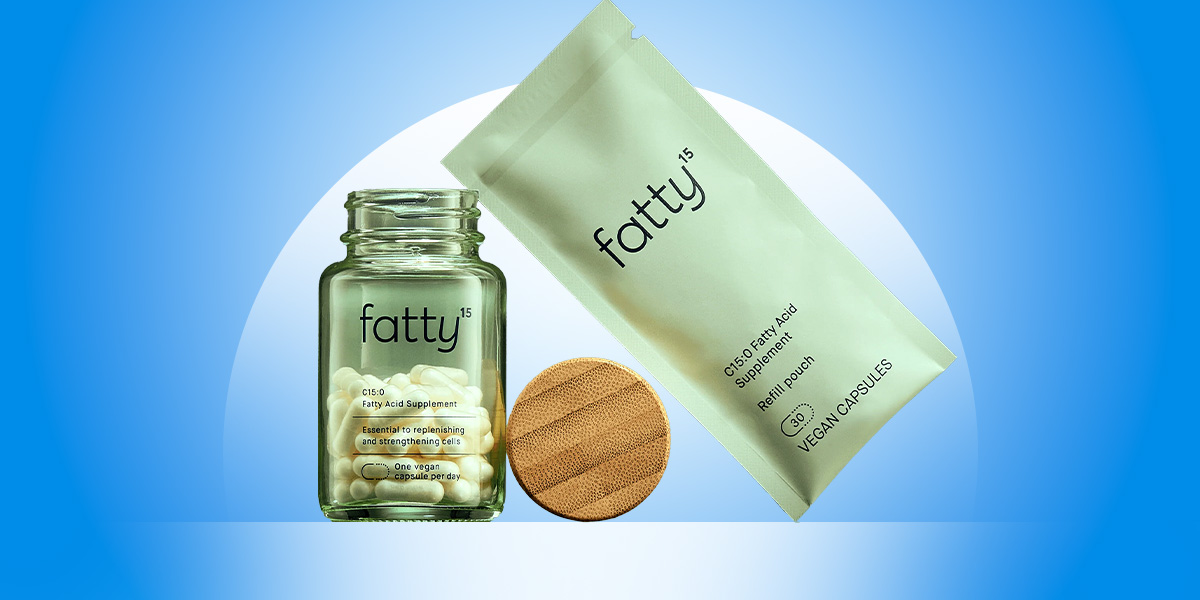
The supplement market is booming, with new products emerging out of thin air. Fatty15 is popping up all over social media, often promoted alongside omega-3s.
While the manufacturer of Fatty15 is not shy to put their product on a pedestal, how much evidence is there, really, to support the idea that C15:0 (also known as pentadecanoic acid) is the first “essential fatty acid” discovered since omega-3s?
Surprisingly, not much.
-
Fatty15 is a supplement containing C15:0, a saturated fatty acid found in dairy.
-
While C15:0 is marketed to support cellular health, mitochondrial function, and longevity, the evidence on this is scarce.
-
C15:0 is not a replacement for omega-3s, as the benefits of omega-3 fatty acids are significantly more well-established.
-
Most information surrounding C15:0 comes directly from the Fatty15 brand, meaning consumers should be cautious before jumping into the trend.
What is C15:0, and why is it in a supplement?
Fatty15 is built around a molecule called C15:0, also known as pentadecanoic acid.
While the brand compares C15:0 to omega-3s, C15:0 belongs to a different category of fats. Unlike the well-known essential fatty acids, C15:0 is an odd-chain saturated fat that has recently gained attention.
However, calling C15:0 essential is far-fetched. C15:0 is not considered essential by current scientific standards, and comparing it to omega-3s is deceiving. Not only can C15:0 not replace your daily omega-3s, but the evidence pointing out that this molecule may be beneficial is just emerging.
Are we deficient in C15:0?
The idea behind the Fatty15 supplement is that modern diets lack sufficient amounts of C15:0 and that this deficiency may be linked to aging-related conditions, including inflammation, mitochondrial dysfunction, and weakened cellular membranes.
According to the company behind Fatty15, C15:0 works at the cellular level to:
- Strengthen cell membranes
- Support mitochondrial function
- Reduce oxidative stress
- Balance metabolism-related markers
So, can taking C15:0 support one’s health?
Admittedly, some small and inconclusive initial studies do suggest that C15:0 may be linked to improved cellular function, reduced inflammation, and better metabolic health. Still, it's important to approach these claims with caution.
The evidence surrounding C15:0 is limited, and most of the research so far has been preclinical or observational. Until larger, well-controlled human studies are conducted, the health benefits of C15:0 remain speculative.
What does the research say about C15:0?
We do not have many research studies on C15:0, but the ones we have point out that this fatty acid may be linked to better health outcomes.
For instance, one cohort study concluded that higher blood plasma levels of C15:0, together with C17:0 (a similar fatty acid), are associated with a lower incidence of cardiovascular disease.
But here’s the catch: correlation isn’t causation. Just because people with more C15:0 in their blood seem healthier doesn’t prove the fatty acid itself is responsible, or that supplementing with it will replicate those effects.
Moreover, even the authors of the study mention that C15:0 is studied as a biomarker of dairy fat intake, thus indicating that higher C15:0 levels simply reflect consumption of full-fat dairy products, rather than being the direct cause of improved health.
In other words, benefits observed might stem from broader dietary patterns, not from C15:0 itself.
Cellular fragility syndrome: is it real?
In marketing, fear is a powerful selling tool.
Cellular fragility syndrome is not a formally recognized or widely established medical diagnosis in current clinical practice, and yet Fatty15 is using it to promote their product.
According to the brand, this syndrome is caused by C15:0 deficiency and can be fixed by using their supplement. The idea is based on a recent paper proposing that low levels make our cell membranes ‘fragile’ and more prone to a specific type of cell death called ferroptosis.
But the paper in question has some serious flaws.
Health authorities and peer consensus have not acknowledged cellular fragility syndrome. As of now, it is just a hypothesis built around a single nutrient and largely untested in large-scale human trials.
In addition, the paper's author is actually an employee of Seraphina Therapeutics, Inc. and Epitracker Inc., the companies behind the Fatty15 supplement.
Until there's robust, unbiased research to back it up, cellular fragility syndrome looks more like a sales pitch than a scientific breakthrough.
Moreover, keep in mind that supplements are not meant to treat or cure any medical conditions. That’s the domain of pharmaceuticals, which go through rigorous clinical testing and regulatory approval.
Since Fatty15 is regulated as a dietary supplement, not a drug, it influences the level of oversight and evidence required. And, clearly, the statements on their official website are inflated and commercially oriented.
What to keep in mind if you choose to use C15:0 supplements?
While C15:0 supplementation is being promoted for various health benefits, these claims remain speculative due to a lack of studies.
There are currently no established guidelines or recommended daily intake levels for C15:0, and the optimal dosage for humans is still unknown.
When it comes to overall safety and Fatty15 side effects, it is also hard to know the potential risks.
“So far, short-term human studies and extensive cell-based research have not identified significant risks or toxicity with C15:0 supplementation at studied doses. However, we cannot rule out rare or delayed side effects with the absence of long-term human data, so ongoing research is needed to confirm its safety profile with chronic use,” highlights Seyed Hassan Fakher, MD.
Its potential interactions with other supplements or medications also haven’t been thoroughly studied.
As with any supplement, it’s best to consult with a healthcare provider before starting Fatty15, especially if you’re pregnant, breastfeeding, or have any underlying health conditions.
Fatty15: yet another trend
While Fatty15 is an intriguing newcomer to the supplement world, the trend around it is mostly fueled by marketing rather than scientific consensus.
While there are some research studies behind C15:0, it’s still in its early stages. Human trials are limited, and many of the claims are based on preclinical or observational data. This is not enough to call C15:0 essential.
In fact, Fatty15 marketing might make you think that this fatty acid can replace omega-3s, which is deceiving. Not only do these fatty acids belong in different categories, but the benefits of omega-3s have been long established.
Moreover, this brand's bold claims should make consumers cautious and wary. Although some indications that C15:0 might be beneficial are out there, Fatty15 utilizes fear tactics to sell its products.
2 resources
- PLOS Medicine. Biomarkers of dairy fat intake, incident cardiovascular disease, and all-cause mortality: a cohort study, systematic review, and meta-analysis.
- Metabolites. The cellular stability hypothesis: evidence of ferroptosis and accelerated aging-associated diseases as newly identified nutritional pentadecanoic acid (C15:0) deficiency syndrome.






Your email will not be published. All fields are required.