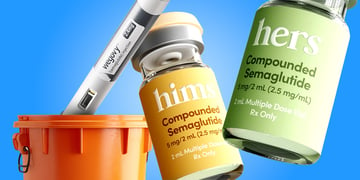
In January 2026, Novo Nordisk launched a new pill version of its popular weight-loss drug, Wegovy. Just before its release on TrumpRX, a website dedicated to helping patients pay the lowest prices for certain medications, Hims & Hers announced it would produce a cheaper version.
The company stated that Novo’s pill knock-off would cost $49 for the first month and $99 for each following month, much cheaper than the original pill, which starts at $149.
When Hims & Hers thought they had won big in the weight-loss industry, federal officials dashed their hopes by stating the drug might be illegal. In this article, we examine the differences between the original and knock-off pills and why the uproar happened.
-
Research shows that semaglutide oral pills help people lose weight, but those who stop taking them gain about 1.8 lbs per month.
-
Certain compounded formulations contain unknown impurities at levels as high as 33%, which may provoke negative immune responses.
-
The FDA has announced plans to restrict the use of GLP-1 ingredients in compounded drugs marketed by companies such as Hims & Hers.
What is Wegovy?
Some people might think Wegovy is just another name for Ozempic. While they contain the same active ingredient, semaglutide, and come from the same company, their similarities end there.
Ozempic has a lower dose of semaglutide (up to 2 mg) and is mainly prescribed for people with type 2 diabetes. Wegovy is usually prescribed to manage weight in adults and has a higher dose of semaglutide (2.4 mg injections and 25 mg pill).
Wegovy alters how the brain senses hunger and responds to cravings for high-fat foods. It mimics the hormone GLP-1, which your body uses to tell your brain that you’ve eaten enough.
Quick weight loss
For individuals who are reluctant to use injections, the development of a pill offers a more accessible method for achieving weight management goals.
Clinical trials have demonstrated its effectiveness. Dr. Jason Schroder, Medical Director at Craft Body Scan, notes that the OASIS 4 trial found that patients taking a 25 mg oral pill lost approximately 13.6% of their body weight after 64 weeks. “From what I’ve seen, those numbers translate to real gains in blood pressure as well as blood sugar,” he adds.
Wegovy shot vs. oral pill
The oral pill may seem more convenient, but it doesn’t work as well if you don’t follow the instructions exactly. The main difference between the injection and the pill is how often you take them — the injection once a week, while the pill you must take every day.
Dr. Schroder notes that the injection is more effective because it is delivered under the skin, allowing the body to absorb nearly 89% of the medication immediately.
“The pill is a different story. You have to take it on an empty stomach every morning, and no more than 4 ounces of water, and wait at least 30 minutes before eating or drinking anything. If you skip those steps, then only about 1% of the oral dose actually makes it into your bloodstream. From what I've seen at our practice, the patients that travel or have non-predictable mornings do better with the weekly shot.”
Usage for life
Research indicates that using the semaglutide oral pill or injections may provide only a short-term solution. A meta-analysis published by Oxford University found that individuals who discontinued semaglutide gained approximately 1.8 lbs per month and returned to their initial weight after 1.5 to 2 years.
“That’s faster than most people think,” Dr. Schroder warns. “The most common side effects are gastrointestinal and include nausea and vomiting. These tend to appear early and typically disappear within four to eight weeks. I always advise people, this is a conversation you need to have with your own doctor because every patient's medical profile is different.”
Danger of knock-offs
The cost of Wegovy oral pills, at $149 for the first month and $199 for the following months, may be too expensive for some individuals. As a result, many seek more affordable alternatives, such as compounded semaglutide versions.
According to Novo Nordisk’s research, certain compounded formulations contain unknown impurities at levels as high as 33%. These impurities may provoke immune responses, leading to severe or life-threatening reactions.
“I understand the pressure financially. But when a product has no standardized dosing and no quality testing, you are putting something in your body that nobody has properly checked,” Dr. Schroder cautions. “For anyone thinking of these alternatives, talk to your doctor and don't go with what the U.S. Food and Drug Administration (FDA) hasn’t actually reviewed.”
FDA warning
The FDA has announced plans to restrict the use of GLP-1 ingredients in compounded drugs marketed by companies such as Hims & Hers, citing concerns regarding quality, safety, and potential violations of federal law. The agency states that companies cannot represent non-FDA-approved compounded products as generic versions of FDA-approved drugs.
As a result, Novo Nordisk has initiated legal action against Hims & Hers for marketing unapproved and untested copies of the Wegovy pill and injections in the U.S. Novo Nordisk is seeking a permanent injunction to prevent Hims & Hers from selling compounded versions of its drugs. At present, Hims & Hers has withdrawn its copycat oral pill from the market.
Lawsuits against compounded drugs
Historically, lawsuits have been filed against compounding drug companies for producing medications in unsafe or unsanitary conditions. Jeffrey Nadrich, a Lawyer, gives an example of the New England Compounding Center (NECC). In 2012, NECC was found to have produced compounded drugs in unsanitary conditions.
“Ultimately, 25 people died from fungal meningitis infections linked to unsanitary conditions at the NECC facility. Authorities brought criminal charges against the NECC employees responsible for allowing the dangerous compounded drugs to be produced,” Nadrich explains. “NECC attempted to circumvent FDA oversight by classifying its business as a ‘pharmacy’ dispensing valid prescriptions.”
However, Nadrich is not blaming other vendors.
“There is absolutely no indication that vendors currently offering compounded GLP-1 medications have harmed consumers or are operating unlawfully. To prevent another tragedy like NECC, the FDA must maintain vigilant and consistent regulatory oversight to monitor the safety of all pharmaceutical products, including compounded medications.”
Final verdict
Ongoing competition among companies in the semaglutide injection and pill market may put people at risk.
Before selecting a medication, it is essential to consult a healthcare professional and avoid drugs not approved by the FDA. However, if the semaglutide pill appears to be the only remaining option for weight loss, it is important to consider that research indicates a high chance of regaining lost weight.
5 resources
- The New England Journal of Medicine. Oral semaglutide at a dose of 25 mg in adults with overweight or obesity.
- British Medical Journal. Weight regain after cessation of medication for weight management: systematic review and meta-analysis.
- Pharmaceutical Research. Impact of manufacturing process and compounding on properties and quality of follow-on GLP-1 polypeptide drugs.
- U.S. Food and Drug Administration. FDA intends to take action against non-FDA-approved GLP-1 drugs.
- Federal Bureau of Investigation (FBI). Information for victims in the New England Compounding Center (NECC) case.






Your email will not be published. All fields are required.