Sometimes in the back of our heads, we think about how long we will live. Although there is no miracle way to predict that, several basic assessments can evaluate strength, balance, and cardiovascular health.
These factors are important indicators of physical capability and are frequently associated with longevity. Here we will examine several tests, explain how to perform them, and discuss the importance of their results.
-
The fitness longevity assessment includes the sitting-to-stand, one-leg balance, push-up capacity, walking speed, and grip strength tests.
-
Combined fitness longevity tests are more likely to predict mortality than single tests.
The sitting-rising test
The sit-to-rise test (SRT) is a non-equipment assessment developed by Dr. Claudio Gil Araujo to measure musculoskeletal fitness, strength, flexibility, and balance. A 2025 study found it may predict longevity.
Researchers selected 4,282 individuals aged 46 to 75 years, 68% of whom were men. All of them completed the SRT and were divided into five groups based on performance. Over about 12 years, researchers tracked their initial SRT scores and mortality.
The results showed a strong relationship between SRT scores and all-cause mortality risk:
| SRT score groups | Mortality rates |
| 0–4 | 42.1% |
| 4.5–7.5 | 20.4% |
| 8 | 11.1% |
| 8.5–9.5 | 7.0% |
| 10 | 3.7% |
How to do the test?
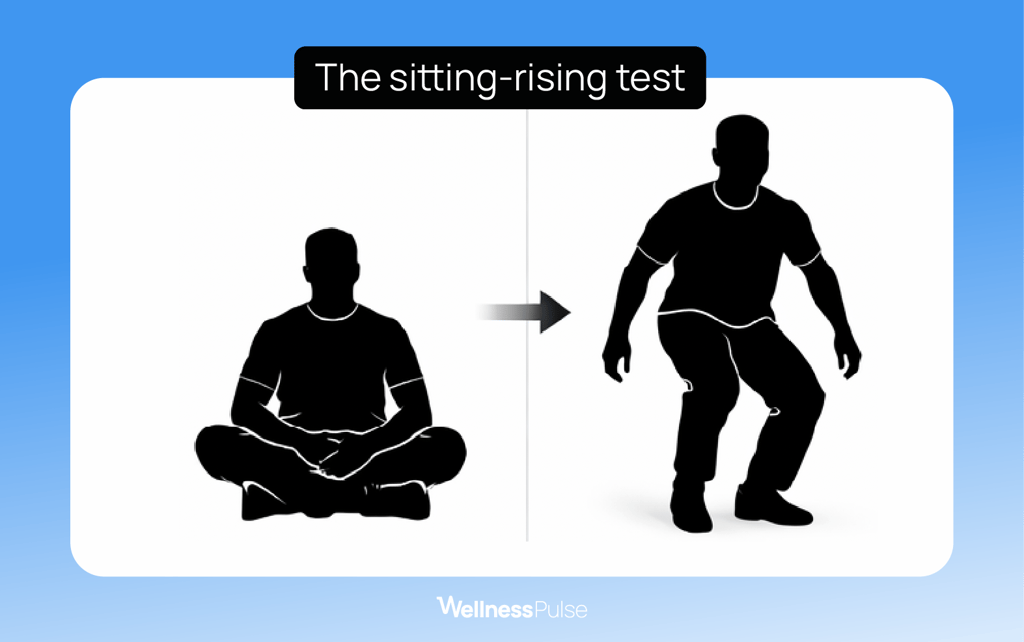
The goal of this assessment is to sit down on the floor from a standing position and stand up using as little support as possible. The test is scored on a 10-point scale: five points for sitting down and five for standing up.
You lose a point for each hand, knee, or other body part you use for support, and half a point for being unsteady or losing balance. Adults in their 30s or 40s should aim for 10, while people over 60 who score 8 are considered in really good shape.
One-leg balance test
As we get older, maintaining strength and balance is as important as ever. That said, a one-leg balance test may predict how well you are aging and your risk of falls or long-term mortality.
A 2022 study assessed 1,702 participants (68% men) who did a 10-second balance test. 20.4% couldn’t complete the task. Over a 7-year period, researchers followed up and found that 17.5% of people who couldn’t keep balance on one leg for 10 seconds had died. In comparison, only 4.6% of those who could do it had the same outcome.
Another study noticed that individuals who balanced for less than 15 seconds had a higher risk of falls at age 68 than those who balanced for 30 seconds.
How to do it?
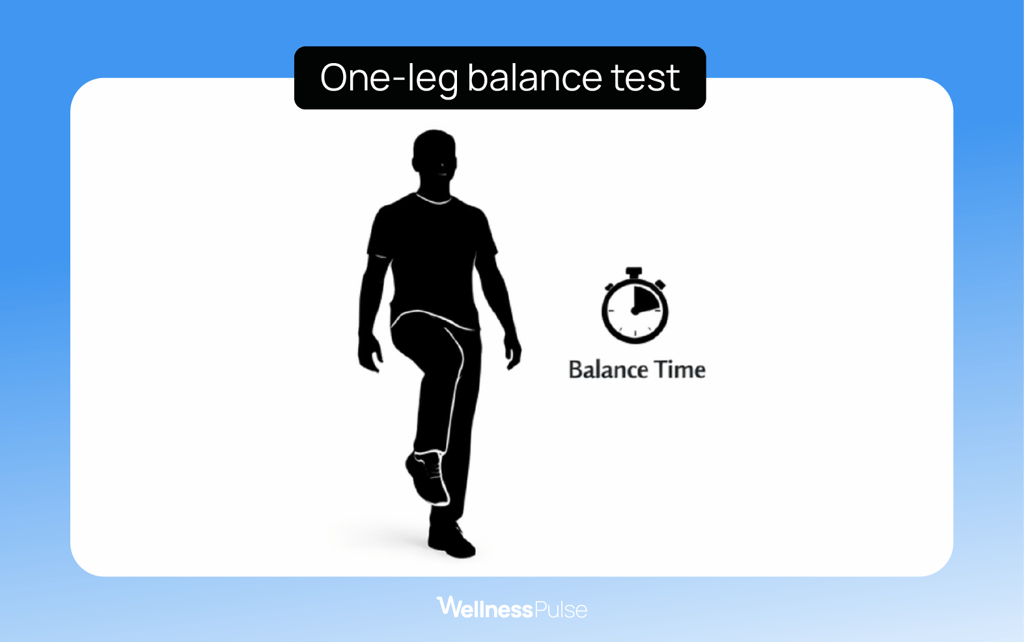
Stand on a flat surface near a wall or chair for safety. Put your hands on your hips or cross them over your chest.
Then, lift one foot off the floor, keeping a slight bend in the stance leg’s knee. Start timing when the foot is lifted. Stop timing if your raised foot touches the ground, your hands move, or you lose balance.
Push-up capacity test
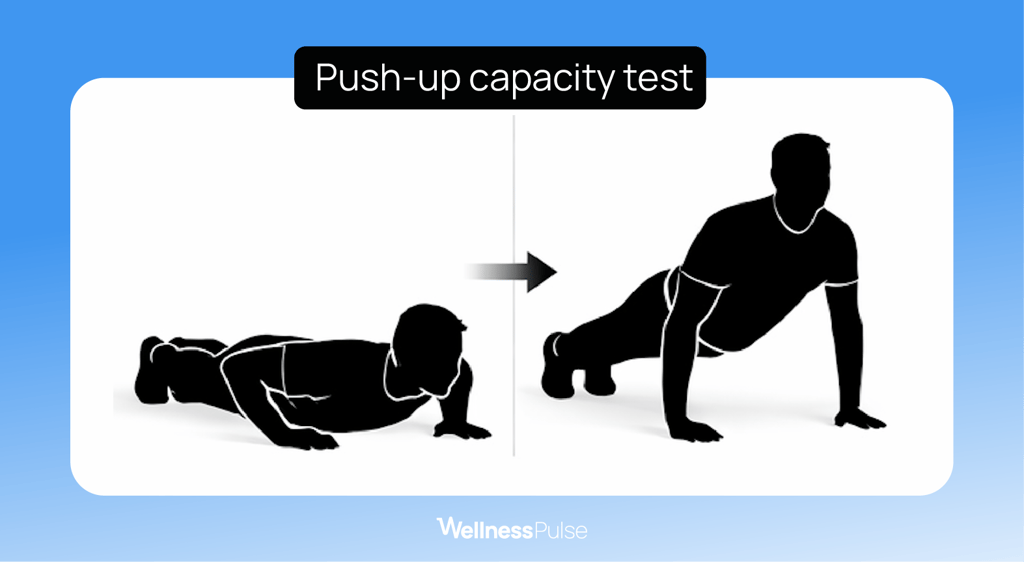
A recent study analyzed the correlation between cardiovascular disease (CVD) risk and push-up capacity. They collected data from 1,104 men, aged 39.6 years on average, with a median follow-up of 10 years.
Participants' results were recorded at the start, and each completed an annual physical and a health questionnaire. Over 10 years, of 37 CVD occurrences, only one occurred in a group that could do more than 40 push-ups. The researchers found these men had a 96% lower risk of CVD than those who could do fewer than 10 push-ups.
However, this study was conducted with active middle-aged men, so the results cannot be generalized to women or less active people in other age groups. Still, the more push-ups you can do, the lower your risk of CVD may be.
Good fitness results for push-up count
The numbers can vary depending on physical capabilities, injuries, age, gender, and other factors. However, here is an estimated average push-up count by age and gender:
| Age | Number of push-ups for women | Number of push-ups for men |
| Around 25 | 20 | 28 |
| Around 35 | 19 | 21 |
| Around 45 | 14 | 16 |
| Around 55 | 10 | 12 |
| Around 65 | 10 | 10 |
Walking speed test
One review analyzed data from 9 large studies with 34,485 adults aged 65 or older. The main goal was to see if walking speed (gait speed) may predict survival outcomes.
Participants were followed for 6 to 21 years. According to review calculations, for every 0.22 mph (0.1 m/s) increase in gait speed, mortality risk decreased significantly.
For adults under 40–50, the best walking pace is 3 mph or more (≥1.3 m/s). Because gait speed in younger adults changes more slowly, most research focuses on older individuals. Here are the key walking speed metrics for longevity over age 65:
| Exceptional longevity | ≥2.7 mph or ≥1.2 m/s |
| Optimal aging | ≥2.2 mph or ≥1.0 m/s |
| Average | ≈1.8 mph or ≈0.8 m/s |
| Accelerated aging | ≤1.3 mph or ≤0.6 m/s |
How to assess gait speed?
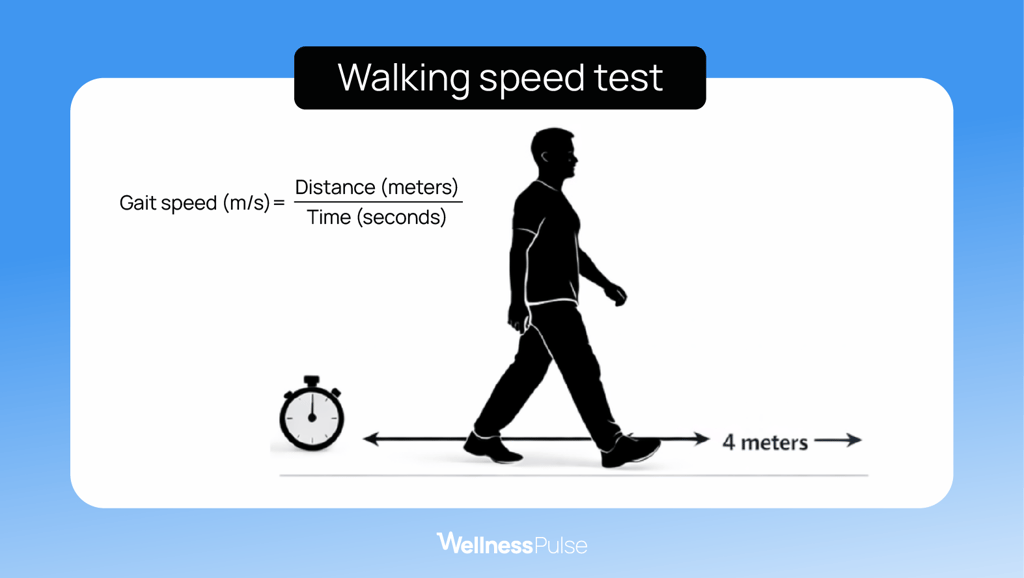
To find your walking speed, measure 4–10 m (13–33 ft) on a straight, flat surface. Your main goal is to calculate the time it takes to walk that distance. For accurate results, walk at your regular pace, not as fast as you can. Then, divide the distance by the time to get your gait speed.
Grip strength test
Handgrip strength is widely considered a reliable indicator of overall muscular strength and physical function. Lower grip strength is associated with a higher risk of all-cause mortality.
A 2011 study tried to prove that. They followed 2,239 men aged 56–68 for 44 years, allowing a full analysis of lifespan outcomes. They found that people who reached 100 years of age were 2.5 times more likely to be in the highest third of grip strength than those who died before age 79.
For a full round-up about grip strength, its measuring, and training, read our article.
Should you trust these tests?
One study examined this topic. They selected 422 older adults and followed them for 7 years. Before that, participants underwent physical and functional fitness tests, including balance, agility, grip strength, a 6-minute walk, and SRT assessments.
Researchers then combined results into a general fitness function index (GFFI-6). Their aim was to determine which better predicts mortality from all causes: GFFI-6 or tests alone.
They concluded that a composite measure combining several fitness test predictions was better, since survival rates varied. For example, GFFI-6 scores were associated with about 4.7 times higher mortality risk, while SRT test scores predicted 2.5 times higher risk, and balance tests 2.7 times higher risk.
Still, it is hard to say if you can precisely predict an individual’s mortality with these tests. However, poor performance may lead to poorer long-term outcomes.
Bottom line
Doing those tests can be a fun game at a party to see who performs better, or something to try when you have nothing else to do. Failing some of these tests might be even a sign to start eating healthier or increase physical activity.
However, negative results may cause stress and should be interpreted with caution. If you're concerned about your longevity, it is better to seek professional advice on how to evaluate and extend it.
8 resources
- European Journal of Preventive Cardiology. Sitting–rising test scores predict natural and cardiovascular causes of deaths in middle-aged and older men and women.
- Archives of Gerontology and Geriatrics. Impact of physical and functional fitness on mortality from all causes of physically independent older adults.
- British Journal of Sports Medicine. Successful 10-second one-legged stance performance predicts survival in middle-aged and older individuals.
- Journal of the American Medical Association. Association between push-up exercise capacity and future cardiovascular events among active adult men.
- Journal of the American Medical Association. Gait speed and survival in older adults.
- American Journal of Preventive Medicine. One-legged balance performance and fall risk in mid and later life: longitudinal evidence from a British birth cohort.
- Mayo Clinic. How fit are you? See how you measure up.
- GeroScience. Midlife muscle strength and human longevity up to age 100 years: a 44-year prospective study among a decedent cohort.





Your email will not be published. All fields are required.