
When it comes to new health trends, I usually remain skeptical. Especially if it is another water ‘hack’ — because adding something to your water to achieve better health sounds too good to be true (and usually is). We have all seen lemon water; it is a staple in many wellness routines, but experts note that it does not really have significant effects, at least not to the degree of what wellness influencers try to make us believe.
-
Clove water is often surrounded by grandiose claims but typically delivers modest results, if any.
-
Scientific evidence supports some benefits (e.g., antioxidant and antimicrobial effects), but the research on the topic is scarce.
-
Most evidence stems from concentrated extracts or preliminary studies, not clove-infused water.
-
There are also some risks, especially with high doses, oil forms, or if you’re on certain medications.
What clove water might offer
While research does point out that cloves may have several benefits, most current studies have been conducted either on animals or in vitro, with essential oil derived from cloves, not with clove water.
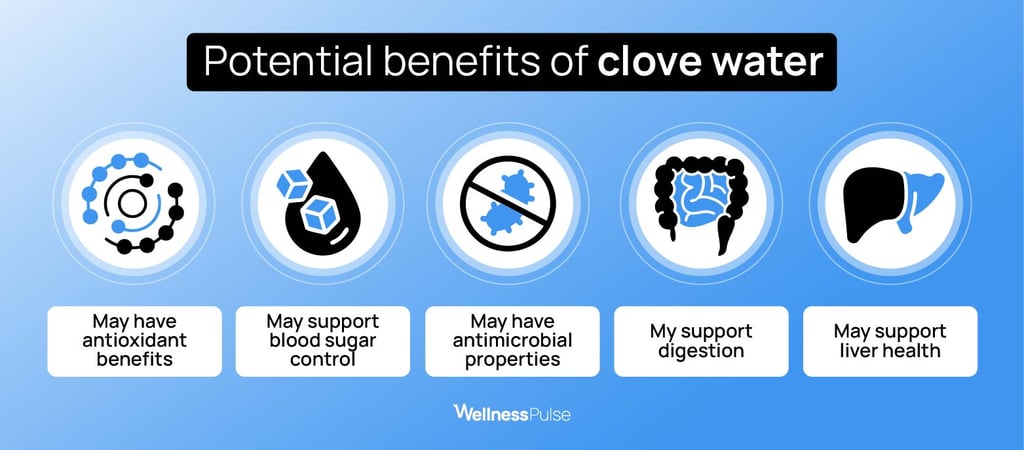
May have antioxidant benefits
“Cloves contain antioxidants, which are compounds that protect our bodies from free radical damage,” says Lena Bakovic, Registered Dietitian Nutritionist.
Clinical studies showed that clove extracts demonstrate free-radical-scavenging activity, which may help protect cells from damage linked to aging and chronic diseases. However, it’s worth noting that most of this evidence came from concentrated extracts, not the small amounts you’d get from steeping a few cloves in water.
May support healthy blood sugar control
In one small pilot study, people who took clove extract supplement for 30 days had lower blood sugar after meals, and some also had lower fasting levels. Lab tests suggest it works by helping the body use sugar better and slowing down how quickly carbs break down. However, the study used polyphenolic clove extract at a 250 mg per day dosage, not clove water.
May have antimicrobial properties
Research hinted that cloves can inhibit the growth of certain bacteria and fungi.
While this highlights clove’s natural antimicrobial potential, clove water likely contains much lower concentrations, making the impact far less pronounced in daily use.
May support digestion
“Clove water can play a role in reducing bloating associated with the digestive process,” says Bakovic. While research on cloves’ digestive benefits is limited, they have long been used traditionally for this purpose.
Right now, most evidence to support these benefits comes from rodent studies. For instance, one study showed that clove oil may help prevent stomach ulcers by boosting mucus production, while another study suggested that clove could be beneficial in reducing constipation.
May support liver health
An animal study on cloves showed that cloves may increase biomarkers that protect against liver damage. However, no human studies have been conducted on this particular matter, meaning the effects remain speculative, with unknown needed dosages.
Moreover, too much of certain active compounds, such as eugenol, might actually cause liver damage. If you want to incorporate clove water in your routine for liver health, it is best to consult your doctor.
How to make clove water
Two main methods are used to make clove water. Below are some recipes suggested in wellness communities:
- Overnight clove water. Add 3–4 whole cloves to a glass of water and let it sit overnight at room temperature. Strain and sip throughout the day.
- Warm simmer method. Combine 1 teaspoon of whole cloves with 2 cups of water, then simmer on the stovetop for around 10 minutes.
Side effects of clove water
In small doses, clove water appears to be mostly safe. However, as noted by Bakovic, drinking clove water regularly or excessively may have some risks.
Too much eugenol, which is one of the active compounds in cloves, may cause liver damage or irritation.
Moreover, some people may have an allergic reaction or sore mouth/throat from consuming clove water.
Lastly, because cloves can thin the blood, anyone on blood-thinning medications should avoid drinking clove water.
Clove water: a great example of a fad
I’ve been working in the wellness niche for over two years now, and in that time, I’ve soaked up quite a lot of health trends. I think most fads have one major thing in common: they take something simple (just add some cloves to your water!) and surround it with a ton of claims.
Go big or go home — that’s how I’d describe ‘the rule’ behind any viral content. That’s why we have the ‘oatzempic’ drink, protein for weight loss, and… well, clove water.
And trust me, I’m not immune. Whenever I come across this kind of exaggerated content online, something in me lights up. But when I look closer, it usually comes down to the same old truth: if it sounds too good to be true, it probably is.
Clove water may offer a few benefits, but if you expect it to radically transform your health, you’ll likely be disappointed.
6 resources
- Asian Pacific Journal of Tropical Biomedicine. Clove (Syzygium aromaticum): a precious spice.
- Brazilian Journal of Microbiology. Microbicide activity of clove essential oil (Eugenia caryophyllata).
- Galen Medical Journal. Protective effect of hydroalcoholic extract of clove on thioacetamide-induced hepatotoxicity animal model: effects hydroalcoholic extract of clove against hepatotoxicity.
- BMC Complementary and Alternative Medicine. Water-soluble polyphenol-rich clove extract lowers pre- and post-prandial blood glucose levels in healthy and prediabetic volunteers: an open label pilot study.
- Naunyn-Schmiedeberg's Archives of Pharmacology. Gastroprotective activity of essential oil of the Syzygium aromaticum and its major component eugenol in different animal models.
- Nigerian Quarterly Journal of Hospital Medicine. Gastrointestinal effects of Syzigium aromaticum (L) Merr. & Perry (Myrtaceae) in animal models.






Your email will not be published. All fields are required.