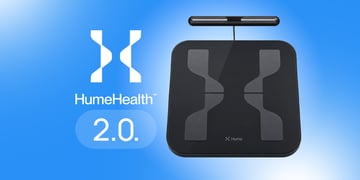
When you are trying to make progress with your fitness, weight alone does not always tell the full story. The number on the scale might barely move, even while your body composition changes. That is the idea behind Hume Body Pod 2.0 — it was built to help you track changes you can’t see from overall weight alone.
Before the Hume Body Pod 2.0, we had tested Hume Health’s first-generation smart scale, also known as the Body Pod, and found it to be one of the best smart scales on the market. Once we test Pod 2.0, we’ll update this review as well, but for now, we've compiled all the essential information we have gathered to review what we’ll be expecting with this new release.
Quick overview of Hume Body Pod 2.0
Before we jump into the comparison, here’s what Pod 2.0 specs look like on paper:
| Metrics tracked | 45 in total, including weight, body fat percentage, visceral fat, lean mass, segmental muscle balance, metabolic rate, and body age |
| Multiple users | Yes, up to 24 |
| Sensors | 8-frequency sensors, retractable hand‑bar for segmental analysis |
| Battery | Rechargeable |
Hardware updates with Hume Body Pod 2.0
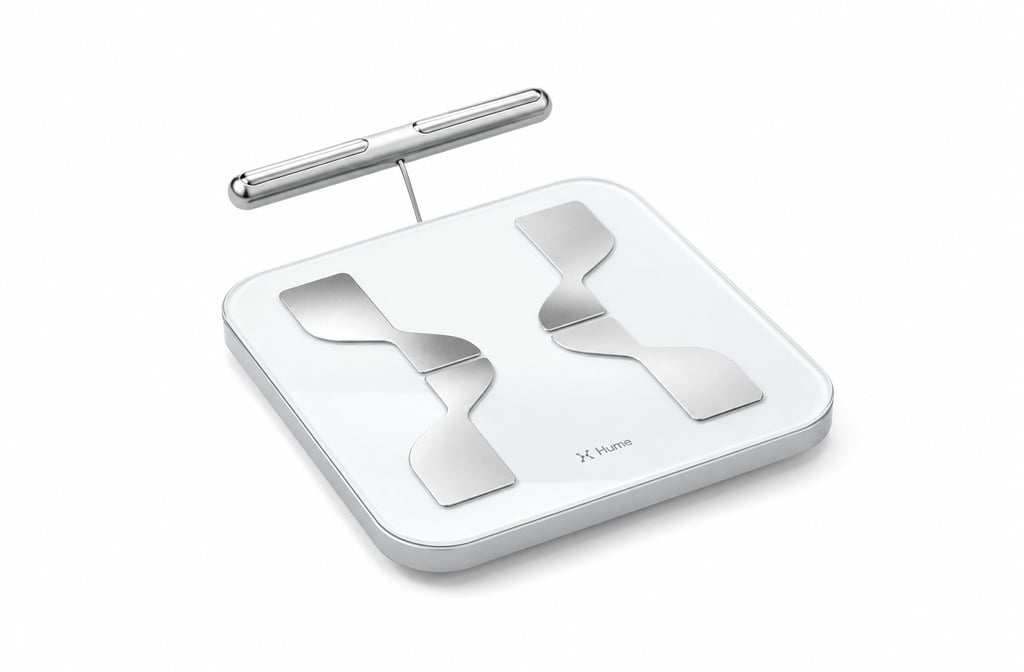
Most of the changes in Hume Body Pod 2.0 are related to software, not hardware. However, some are still expected, so let’s get them out of the way before we jump into the software side of things
New sensor technology
According to Hume, Pod 2.0 features upgraded sensors compared to the previous version, though bioelectrical impedance analysis (BIA) remains its foundational technology. What we expect from these sensors is potentially better accuracy.
Heart rate sensor
Heart rate is now included as part of the scanning experience, giving users another metric within the same check-in. This was available in other popular smart scale models, such as Withings Body Scan, so the addition does not surprise us here.
Software upgrades: Understand your metrics better
Hume Body Pod has always been presented as a tool to help you understand changes in your body, but now the brand is taking it a step further. So, while you won’t get more metrics, the enhanced algorithm provides more actionable insights.
Hume HealthOS
With Pod 2.0, body scans sit alongside other health data, including sleep, activity, recovery, heart health, and nutrition. The goal is to make each scan feel less like an isolated reading and more like part of a fuller health picture.
Hume AI
Hume has already used AI-based interpretation on its platform, but Pod 2.0 places even greater emphasis on explaining what changed between scans. Instead of only showing body-composition data, the app is meant to help users understand the trends behind it.
Digital twin
With Pod 2.0, you’ll be able to track your changes visually — the scan won’t give you mere numbers but will also update your 3D avatar. This can be especially useful for those who are gaining muscle and losing fat, as the weight doesn’t give a full picture of the progress.
Moreover, as you get used to your changes, you might not notice how much progress you have made by looking at yourself in the mirror, so a 3D avatar that adapts to your changes is here to keep you motivated and visually informed.
Is Hume Body Pod 2.0 accurate?
Accuracy is still one of the biggest questions people have when choosing a smart scale, and that will likely be just as true for the Hume Body Pod 2.0.
Like the original Body Pod, Pod 2.0 is built around bioelectrical impedance analysis, or BIA. More specifically, it uses 8-frequency sensors and a retractable hand bar for segmental analysis, which suggests a more advanced setup than a basic bathroom scale. In theory, this should allow it to deliver more detailed body-composition estimates by measuring the body at multiple frequencies and from more contact points.
That said, it is important to keep expectations realistic. Even with upgraded sensors and improved algorithms, Pod 2.0 is still an at-home body-composition scale, not a medical-grade scale.
Smart scales like Pod 2.0 estimate your metrics using electrical signals and software models, whereas a DEXA scan measures body composition much more directly and remains the gold standard. But since a DEXA scan requires a person to visit a clinic and is generally used as a diagnostic tool (for osteoporosis, for example), not a tracking device, smart scales like Pod 2.0 remain useful and impressively capable for home use.
In other words, while Hume Body Pod 2.0 is not likely to match the precision of a clinical test, and can’t be used to diagnose any conditions, it can still be a valuable tool for tracking long-term trends and staying consistent with your fitness goals.
For most people, the real value of a smart scale is not perfect precision but the ability to track changes over time. That is where Hume Body Pod 2.0 seems most promising, thanks to its multi-frequency sensing, segmental analysis, and upgraded sensor setup, which should make trend tracking more useful.
Who is Hume Body Pod 2.0 best for?
Hume Body Pod 2.0 is ideal for anyone who wants a more comprehensive view of their body composition beyond just weight.
For instance, if you are focused on gaining muscle and losing fat at the same time, Pod 2.0 offers useful data. Sometimes the number on the regular scale won’t change much even as body composition improves, which can be especially frustrating and discouraging. Pod 2.0 has been designed to track changes beyond weight.
Moreover, Pod 2.0 can be an appealing device for those working towards longevity goals, not just weight loss. What sets it apart from competitors is its comprehensive view of wellness.
One of the things that helps it stand out is Hume’s broader approach to health, in which body scans are meant to sit alongside other insights, such as activity, recovery, heart health, sleep, and nutrition. That makes it a better fit for users who want to understand how different aspects of their health are connected.
Bottom line
Hume Body Pod 2.0 builds upon an already strong predecessor by combining robust hardware with improved software insights.
While at-home bioelectrical impedance devices won’t replace medical-grade scans, the 3D avatar feature, heart rate tracking, and integrated Hume HealthOS make it a feature-rich option for everyday tracking.
If you want more context behind your progress and enjoy deep data analysis, Pod 2.0 is well worth considering.





Your email will not be published. All fields are required.