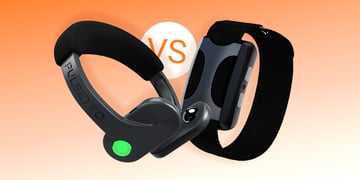
Due to similar proposed benefits, Pulsetto and Apollo Neuro are frequently compared. Both are promoted for stress resilience, sleep support, and heart rate variability (HRV) optimization, but Pulsetto and Apollo Neuro use different underlying technologies.
If you can’t decide which one is more suitable for you, I have compiled all the essential information in one article. I reviewed both the scientific data on these products and consumer concerns, such as pricing and brand reputation, to help you make an informed decision.
Pulsetto vs. Apollo Neuro: quick overview
Before I analyze these devices in more detail, take a look at the key features below.
| Pulsetto | Apollo | |
| Technology | Electric pulses | Haptic vibrations |
| Placement | Neck | Wrist, leg, or chest |
| Certifications | FCC, CE | FCC |
| Usage recommendations | Daily, with typical sessions ranging from 4 to 20 minutes | Every day, for at least 3 hours per day |
| Country of origin | Lithuania | United States |
| Subscription | Not required, $139 per year | Not required, $99 per year |
| Price | From $242.00 | $448.00 |
What is Pulsetto?
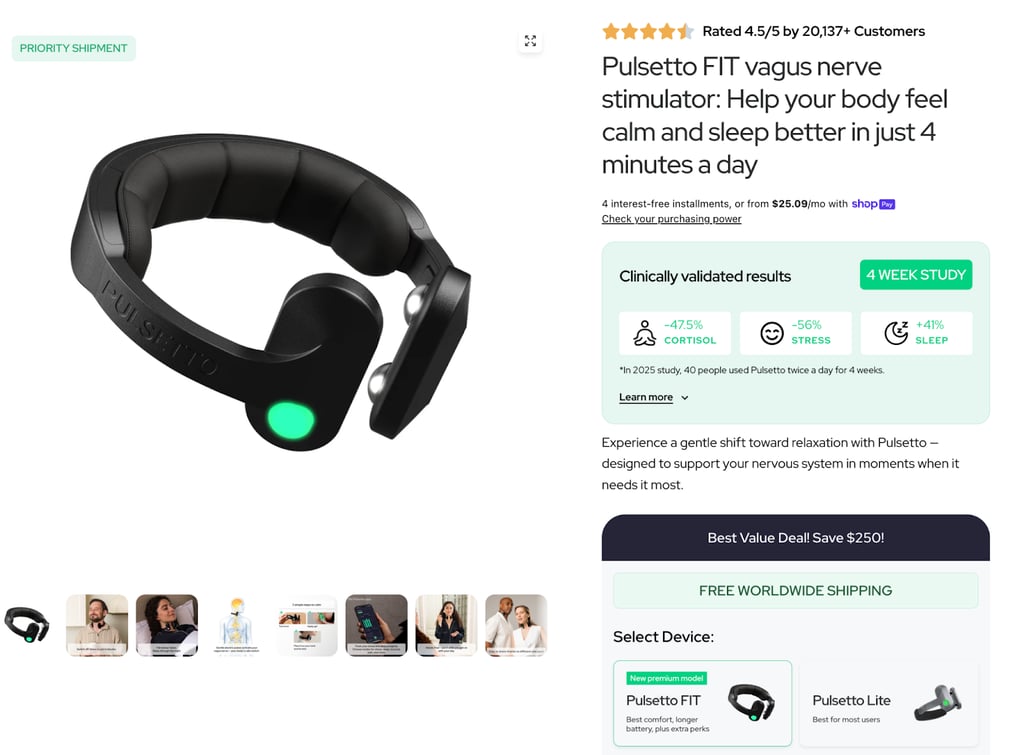
Pulsetto is a non-invasive vagus stimulation device that sends gentle electrical pulses through the neck. This is done to potentially regulate the vagus nerve, which helps control a wide range of involuntary bodily functions, such as breathing, heartbeat, and digestion.
The device offers five stimulation programs:
- Anxiety
- Burnout
- Pain management
- Sleep
- Stress
The stimulation intensity can be adjusted at any time during your session through the application. The electrical currents of Pulsetto can be described as a tingling but tolerable sensation, although some people might find it uncomfortable. For this reason, it is recommended to use the gel that comes with the purchase.
Scientific backing behind Pulsetto
The proposed Pulsetto benefits, such as sleep support, increased stress resilience, and pain management, are supported by a growing body of research on non-invasive vagus nerve stimulators.
Studies have shown that stimulating the vagus nerve may support the body's natural ability to regulate stress responses, potentially leading to improved mood and relaxation. It's important to note that while vagus nerve stimulation shows promise, Pulsetto's cervical (neck) stimulation has been studied less than auricular (ear) stimulation.
That said, Pulsetto is actively building its own evidence base through research. For instance, one published peer-reviewed trial investigated the effects of Pulsetto on physiological responses. The findings suggested that Pulsetto may increase alpha brain waves and reduce systolic blood pressure, indicating a more relaxed state.
While other studies are either ongoing or planned, we should soon see more data on Pulsetto for various potential benefits, such as sleep support.
What is Apollo Neuro?
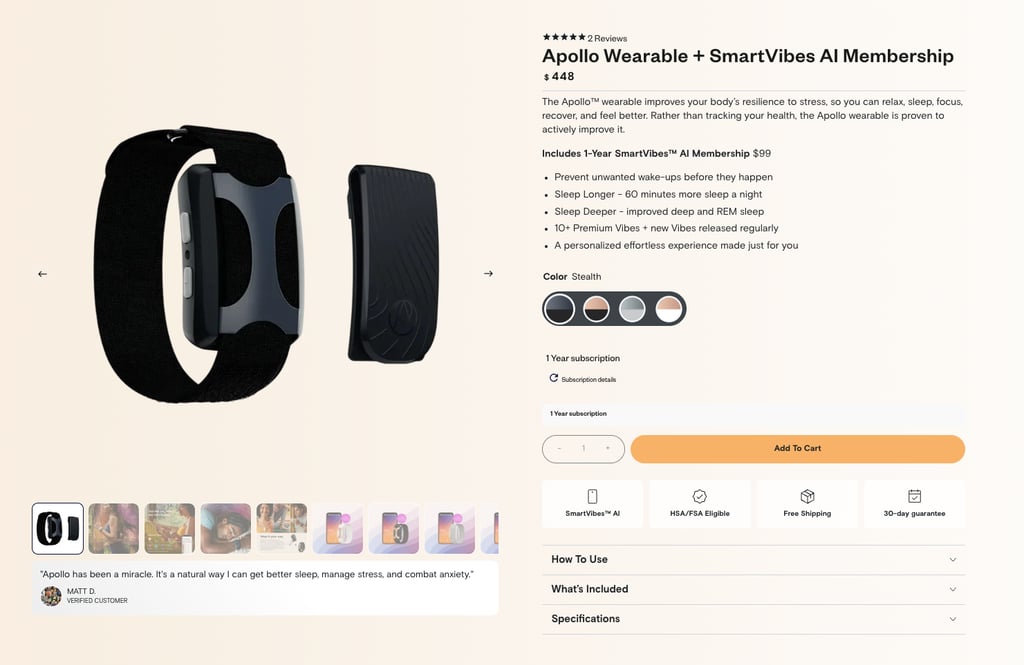
Unlike Pulsetto, Apollo is technically not a vagus nerve stimulation device, although the manufacturer claims similar benefits, including support for sleep quality, better stress management, and improved focus.
In addition, the technology behind the product may appear similar. Both devices are wearable, non-invasive gadgets that deliver stimulating signals through the skin. Except that Apollo Neuro uses vibrations rather than electrical currents.
Users describe these vibrations as pleasant or at least not uncomfortable, meaning Apollo Neuro can be an alternative to vagus nerve stimulation if you experience sensitivities and prefer a gentler approach.
Scientific backing behind Apollo Neuro
Apollo Neuro has been used in several clinical trials.
For instance, one study investigated whether calming vibrations from a wearable device could support athletic recovery. The technology used in the study is licensed to the Apollo Neuro wearable. Athletes who perceived the vibrations as more calming showed an increase in HRV, reflecting greater ‘rest and recover’ activity.
A clinical trial on medical and pharmacy students found that Apollo Neuro may support burnout symptoms, while a study on patients with systemic sclerosis concluded that it may support fatigue. While the studies had relatively small sample sizes (67 and 25, respectively), these early findings suggest that Apollo Neuro may offer benefits across various contexts.
Currently, more studies are underway, including sleep quality, Long COVID-19 symptoms, and symptomatology associated with ADHD.
It's important to note that Apollo Neuro is not a vagus nerve stimulator. Vagus nerve stimulators have been more extensively studied compared to vibrational touch stimulation, the technology behind Apollo Neuro.
Pulsetto vs. Apollo Neuro: customer reviews
For this section, I looked at real-life customer reviews on platforms such as Trustpilot. Pulsetto has a ranking of 4.1 out of 5, while Apollo Neuro has 3.2. However, Pulsetto has over 2,000 reviews, while its competitor has only 214, making it harder to compare the two.
Users of both devices reported improved sleep, enhanced stress resilience, and HRV, as well as overall well-being. Pulsetto and Apollo Neuro are also praised as great additions to relaxation routines, with people stating they help them unwind.
For Pulsetto, negative feedback is mostly related to their app, which is glitchy for some users. Some are also disappointed that you can’t use this device without it, especially frustrating when it crashes. The same could be said of Apollo Neuro, and a good chunk of customers expressed disappointment due to various app bugs.
When it comes to customer service, Pulsetto has received mixed reviews. While some claim it is easy to reach their customer support team, others have had to wait for replies. Several customers have expressed dissatisfaction due to the hardships in receiving refunds. Apollo Neuro’s customer service also received many complaints about long reply times and issues with returns.
Pulsetto vs. Apollo Neuro: pricing
As both devices are not cheap, let’s compare the prices in more detail.
| Pulsetto | Apollo Neuro | |
| Price | $242.00 (Lite) or $269.00(FIT) | $448.00 |
| Payment options | Can be paid in 4 interest-free payments | No option to pay in installments |
| HSA/FSA eligibility | Yes | Yes |
| Warranty | 2 years | 1 year |
| Money-back guarantee | 30 days | 30 days |
| Subscription | Not required, $139 per year | Not required, $99 per year |
| Other considerations | Requires a continuous supply of gel | N/A |
When comparing the two devices, Pulsetto appears to be a better choice for those on a tighter budget, especially since installment payment options are available.
However, I would like to highlight that Pulsetto is recommended to be used with a gel, which costs $50.99 for 4 gel tubes, each containing 60 grams. This amount should last 4–6 months when used for one person. Apollo Neuro does not require any gel to be used.
Considering that the subscription to Pulsetto is also more expensive, $139 per year, Pulsetto may cost you more in the long run.
Pulsetto Lite vs. Pulsetto FIT
While both versions of Pulsetto are priced almost the same, what are the main differences?
Pulsetto Lite is the previous version, which is still available for sale. Pulsetto FIT was designed to address one of the major drawbacks of Pulsetto Lite: its one-size-fits-all approach. The original version may not be suitable for individuals with slender necks, as it can feel too large.
Pulsetto FIT features a more versatile design that better accommodates smaller necks, ensuring a more secure fit for consistent stimulation. This newest version also has an upgraded battery that should last longer with a new wave-like stimulation.
Pulsetto vs. Apollo Neuro: which one to choose?
Both Pulsetto and Apollo Neuro are wearable devices marketed for stress resilience, sleep support, and HRV optimization, but they take different approaches to achieve these goals.
Choose Pulsetto if you want a device grounded in vagus nerve stimulation, a technology with a broader scientific evidence base. Moreover, Pulsetto could also be considered as a more budget-friendly option as its upfront cost is lower, with the option to purchase the device in installments.
However, Apollo Neuro could be a valuable option for those who find the electric pulses from devices like Pulsetto overwhelming and uncomfortable. Moreover, choose Apollo if you would rather wear the device on your wrist, leg, or chest instead of your neck.
Ultimately, there is no definitive winner, as the best product will depend on your needs.
9 resources
- European Journal of Applied Physiology. Effect of vibroacoustic stimulation on athletes recovering from exercise.
- American Journal of Physiology-Regulatory, Integrative and Comparative Physiology. Acute transcutaneous cervical but not auricular vagus nerve stimulation increases alpha wave brain activity and lowers arterial blood pressure.
- Applied Sciences. The effects of vagus nerve stimulation on stress, competitive anxiety, and depression in elite shooters: randomized controlled trial.
- The Journal of Rheumatology. Wearable in systemic sclerosis: a pilot study of the Apollo wearable demonstrates improvement in fatigue, Raynaud phenomenon and quality-of-life in patients with systemic sclerosis.
- The American Journal of Medicine. Evaluating the impact of Apollo Neuro™ wearable on wellbeing in medical and pharmacy students: a preliminary prospective randomized controlled study.
- American Journal of Physiology-Regulatory, Integrative and Comparative Physiology. Acute transcutaneous cervical but not auricular vagus nerve stimulation increases alpha wave brain activity and lowers arterial blood pressure.
- Clinical Science (London). Clinical perspectives on vagus nerve stimulation: present and future.
- Journal of Affective Disorders. The efficacy and safety of transcutaneous auricular vagus nerve stimulation in the treatment of depressive disorder: a systematic review and meta-analysis of randomized controlled trials.
- Journal of Personalized Medicine. Application of noninvasive vagal nerve stimulation to stress-related psychiatric disorders.



Your email will not be published. All fields are required.